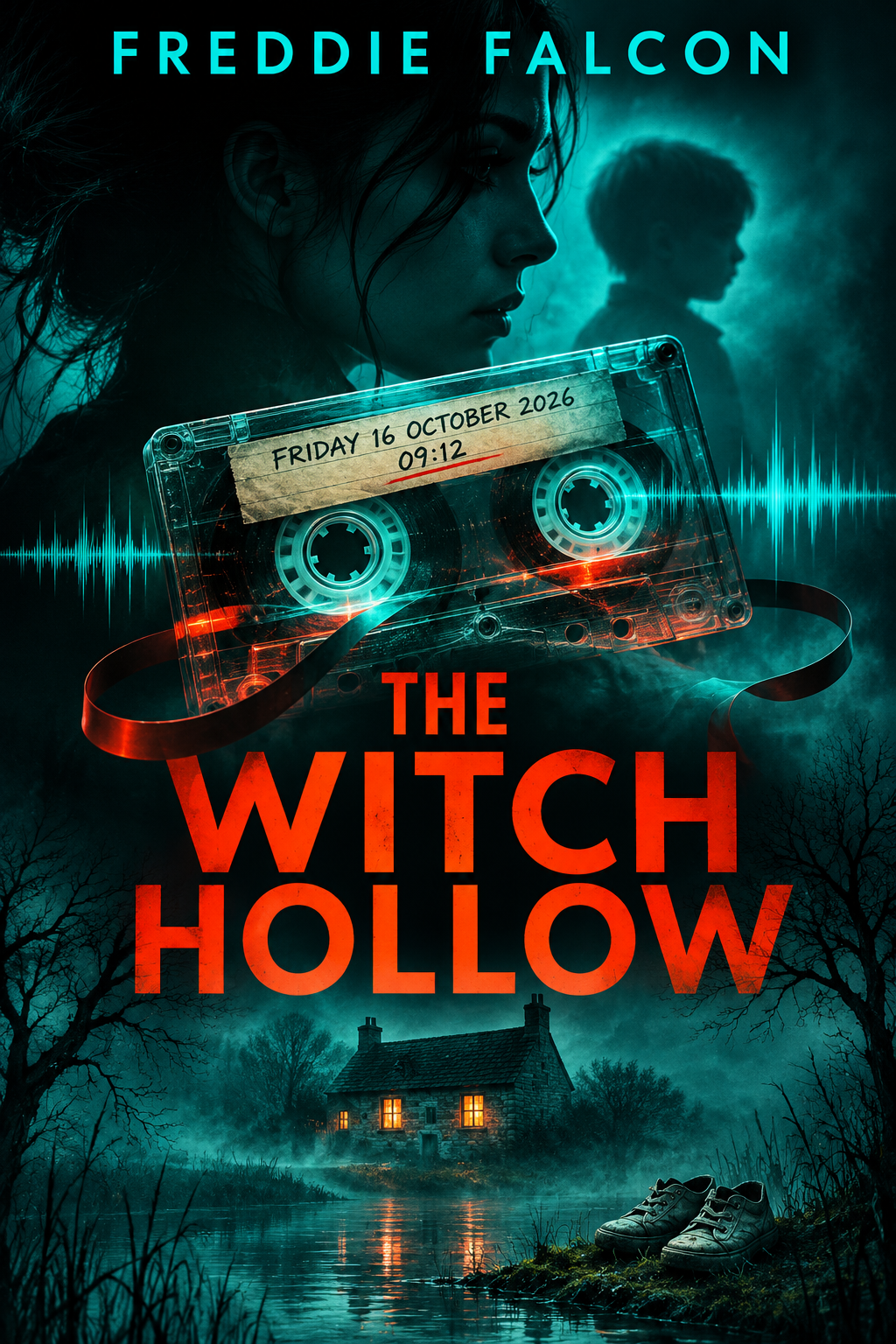
THE WITCH HOLLOW
Freddie Falcon
Copyright © 2026 Freddie Falcon
All rights reserved. First edition.
This is a work of fiction. Names, characters, places and incidents are invented or used fictitiously. Any resemblance to actual persons, living or dead, or actual events is coincidental.
CHAPTER 1 - TOMORROW'S DATE
The cassette was dated tomorrow. On it, a woman with my voice was identifying a dead child.
For almost a day, I thought I had been given time to save him. That was the part I returned to later: the coffee I made, the emails I answered, the screwdriver I held between my teeth while I tried to decide whether to believe what I had heard.
The parcel arrived at eleven seventeen on a Thursday.
I knew the time because the courier rang while I was recording the silence at the end of a damaged interview. His bell spoiled the take. On my monitor, the waveform jumped into two neat peaks.
I let him in wearing the magnifying glasses I used for tape splices.
“Celia Rook?”
I pushed the glasses onto my head.
He handed me a padded envelope. It weighed almost nothing. No return address, no accompanying paperwork. My name and the workshop address had been printed on a white label, with the postcode corrected in blue ink.
Inside was a cassette in a clear case.
Most of my clients sent files. Those who sent physical media usually included a letter explaining why the contents mattered: a father’s wedding speech, a grandmother singing, a witness whose voice had become important after death. This sender had included nothing.
The cassette was a decent brand, a ninety-minute ferric tape. On the paper insert, someone had written:
FRIDAY 16 OCTOBER 2026
09:12
CELIA ROOK — IDENTIFICATION
I checked the calendar above my desk.
Thursday the fifteenth.
There were more dramatic explanations than an incorrect date. Most were also less likely.
I entered it into the intake register as an unsolicited item, photographed the case, and examined the shell. The screws showed no damage. The pressure pad was intact. Along the lower edge, a thread of black grit had caught in the seam.
I brushed it into a folded square of paper before opening the cassette.
People stored recordings in dreadful places. I had once removed enough plaster dust from a christening tape to fill a teaspoon.
The tape inside looked clean.
By noon I had it running through the inspection deck.
At first, there was only a low mechanical hum. Then a scrape, two hard footfalls, and the quick tearing sound of a zip.
A man said, “Take your time.”
A woman breathed in.
I stopped the deck.
The workshop settled around me: traffic beyond the window, the extractor fan in the adjoining repair shop, water ticking through a pipe. Ordinary noises, all of them suddenly much too distinct.
I played the last three seconds again.
The woman’s breath caught halfway in. A small, ugly interruption, almost a snort.
I knew it. I heard it in recordings of myself when I was nervous.
The man spoke again.
“Can you tell me whether you recognise him?”
A pause.
“Yes.”
My voice.
I lifted my hands from the desk.
There are voices you resemble. There are voices a sufficiently good imitation can persuade you to accept. This seemed to be neither. It had the slight rasp I heard whenever I listened to a recording of myself. It had the flat ending I put on a word when I was trying not to cry.
“His name?” the man asked.
“I don’t know.”
“You said you recognised him.”
“I said yes.”
The zip moved again.
Then I heard myself say, very quietly, “Please cover his hand.”
I stopped the tape.
For a while I looked at the transport buttons.
The obvious explanation was fabrication. I had spoken at two restoration conferences. A few recordings of me existed online. With the right software, someone could have assembled this.
It was a spiteful thing to make. But spite did not require an interesting motive.
I digitised the passage and put on headphones.
The mechanical hum ran continuously beneath the conversation. The room had a short, hard reflection: tiles or painted concrete, perhaps, with a larger open space beyond a doorway. I could hear the man shifting his weight as the woman answered. No abrupt changes in the noise floor. No crude edits.
That proved very little. A convincing false recording was still possible.
At the far end of the passage, beyond my request about the hand, something clicked three times.
I listened again.
A small click, a pause, then two closer together.
My stomach tightened.
I reached for my phone and opened my contacts. My mother’s name was still under M, although she had been dead for seven months and the number now belonged to somebody else.
I put the phone down.
My brother used to make that sound with his tongue when he wanted my attention without an adult noticing. One click, then two. I had tried to copy him and never managed it.
I had not heard it since he disappeared.
I was eight then. Owen was six.
The police had searched a stretch of river outside a town called Bellwether. That much I knew from the newspaper cuttings my mother kept in a biscuit tin. I did not remember the river. I remembered Owen’s shoes drying beside a heater, and my mother telling a policeman that he would never have gone near water by himself.
His shoes should have meant he was still in the house.
For years that had been the detail I could not get past.
I took off the headphones.
On the desk, the cassette continued to turn.
I had forgotten to stop it.
A woman’s voice came through the monitor speakers.
“Don’t play the other side.”
It was not my voice this time.
I pressed Stop so hard the button hurt my finger.
A car horn sounded outside. Somebody laughed in the repair shop.
I was standing, although I had no memory of getting up.
The voice had been close to the microphone. Older than mine. Hoarse, with an accent I could not place.
I rewound six seconds and played it again.
Nothing.
I went back further. The zip. My voice. The three clicks.
Then blank tape.
I checked the digital capture. The file was still recording. I marked the place where the warning should have been and enlarged the waveform.
Low-level hiss. A truck changing gear in the street outside, caught by a live microphone I had left armed on the desk.
No speech.
I sat down carefully.
Fatigue could do peculiar things to hearing. My work depended on finding words inside noise; sometimes the mind supplied them too generously. I had warned clients about it. I had stopped a man from spending three thousand pounds trying to recover a sentence his late wife had never spoken.
I wrote the warning on a notepad anyway.
At two forty, I called the courier company.
Their tracking page showed a collection from a parcel shop in Leeds. Customer information was unavailable to the recipient. I was welcome to return the item to the sender.
“There isn’t a sender’s address.”
The woman on the telephone waited.
“What would you recommend?” I asked.
She recommended contacting the sender.
I thanked her and ended the call.
I searched my name alongside the word identification. Then Bellwether. Then Owen Rook.
The same newspaper photograph appeared: Owen on a school chair, his head slightly tilted, one hand tucked beneath his thigh. The scan cut off his left shoe.
I closed the page.
At five, I put the cassette in a locking drawer. I labelled the audio file, made a second copy, and sent both to the off-site backup.
At six, I reopened the drawer.
The cassette had two intact recording tabs. I broke them out with the tip of a screwdriver so that nothing could accidentally overwrite it.
Side B remained unplayed.
* * *
At eight twenty-six the following morning, my friend Mina rang.
“Are you at home?”
“In the workshop.”
I had arrived before seven. The cassette sat on the desk beside a cup of coffee I had forgotten to drink.
“Have you seen the news?”
“What news?”
“A little boy. Near Bellwether.”
I turned towards the window.
Across the street, a man in a green apron was unlocking the florist’s shop. He dropped his keys, crouched to collect them, and stood again. I watched all of it.
“Celia?”
“What happened?”
“They found him this morning. I thought, with Owen—”
“Where?”
“A ditch, I think. I’m sorry. I shouldn’t have called like this.”
“Send me the report.”
“Are you sure?”
“Please.”
The link arrived while she was still speaking.
There was no photograph of the child. Only an image of a narrow lane, two police cars, and a strip of blue tarpaulin beyond a field gate.
An unidentified boy, believed to be between eight and ten years old, had been found shortly after six that morning. Police were asking anyone with information to contact them.
I read the appeal twice.
Then I told Mina about the cassette.
She did not interrupt. When I finished, she asked me to photograph the label and send her the picture.
“Don’t touch anything else,” she said. “And call the police.”
“I know.”
“I mean now.”
I looked at the time.
Eight thirty-four.
Thirty-eight minutes remained before the time written on the insert.
* * *
The first officer who called back asked whether this could be part of an online game.
“No.”
“A prank directed at you?”
“Possibly.”
“And you received it yesterday?”
“The courier record will show that.”
“Do you know the child?”
“I haven’t seen him.”
“But you believe you’re on a recording discussing his identification?”
“Yes.”
His pen scratched over paper. I was grateful he was writing something down.
He asked about my connection to Bellwether. I told him about Owen.
The scratching stopped.
“Your brother’s full name?”
“Owen James Rook.”
“And when was that?”
“July 2003.”
“Hold the line, please.”
The wait lasted long enough for the workshop’s automatic lights to switch off. I waved an arm, and they came back on.
A different voice returned.
“Ms Rook? Detective Sergeant Vale. You have a recording you think may relate to the child found this morning?”
“I don’t know what it relates to. That’s why I called.”
“Will you send us a copy?”
I gave him the download address. He stayed on the line while I forwarded the intake photographs and courier confirmation to the police email address he supplied.
“Keep the original cassette secure,” he said.
“Is someone coming for it?”
“We’re arranging that.”
I heard a door close at his end.
“Ms Rook. Was there anything else in the parcel?”
“No.”
“A letter? An item of clothing?”
“No. Why?”
A pause.
“We’ll need to establish who sent it.”
I looked at the paper square holding the black grit.
“There was some dirt caught in the shell. I kept it.”
“Keep that too.”
I wrote his name on the notepad beneath the warning.
VALE.
“Have you listened to all of it?” he asked.
“No.”
“Then leave it as it is.”
This time, the advice belonged to a real person. I repeated it back to him.
When the call ended, the time was nine eleven.
I put my phone on the desk and watched the minute change.
Nothing happened.
The deck remained silent. No knock came at the door. My computer displayed the same six unanswered client emails.
I laughed once, without wanting to.
Then the telephone rang.
Vale.
“I need to ask you something before you hear it elsewhere,” he said.
I gripped the phone.
“Did you own a red wool coat as a child?”
I looked down at my hands. A tiny crescent of dried adhesive clung beside my thumbnail.
“Yes.”
“What do you remember about it?”
“My mother bought it too big. She said I’d grow into it.”
“The buttons?”
I shut my eyes.
Black. Not round. Little animals. My mother had replaced the original buttons because I complained that the coat looked like a school uniform.
“Rabbits,” I said.
Vale let out a breath.
“Rabbits with one ear folded down. Why?”
“The child had an object in his hand.”
I pressed the heel of my free hand against my mouth.
“Ms Rook?”
I could hear his chair shift, followed by two footfalls.
On the desk, the cassette lay in its open case.
“Can you tell me whether you recognise him?” Vale asked.
I opened my eyes.
The words had the same rhythm. The same slight hesitation after tell me.
For an instant I was back inside the recording, waiting for my own answer.
Then Vale said, “The boy, Ms Rook. Do you recognise the boy?”
“I haven’t seen him.”
“No. Of course.”
Paper rustled.
“I’m sending someone to you. Please stay where you are.”
“Was the button broken?”
He did not answer.
“There should be a piece missing from the bottom. Owen bit it once. He said he wanted to see whether it tasted like liquorice.”
I waited.
“I need you to stop discussing this on the telephone,” Vale said.
After the call, I went to the sink at the back of the workshop and was sick.
When I could stand upright, I rinsed my mouth, washed my hands, and went back to the desk.
The photographs I had taken the previous morning were still open on my computer.
I enlarged the cassette insert.
FRIDAY 16 OCTOBER 2026
09:12
CELIA ROOK — IDENTIFICATION
Below the last line, pressed faintly into the paper, were marks I had taken for scratches in the plastic case.
I tilted the original insert towards the window.
Someone had written on a sheet laid over it. The pressure had left an impression.
I found a soft pencil and shaded the paper lightly, working from the edge.
Five words surfaced.
Not the one you buried.
CHAPTER 2 - THE ROAD TO BELLWETHER
The officer who collected the cassette was young enough to have never owned a machine that played one. She asked me which part contained the recording, then corrected herself before I could answer.
“Sorry. That sounded stupid.”
“It sounded careful.”
Her name was Meena Shah. She photographed the cassette, the envelope, the grit and the shaded insert where they lay. When I started explaining how easily a tape could be damaged, she let me finish.
“We'll package it properly,” she said.
I signed a statement. She asked whether anybody had threatened me, whether I had recently argued with a client, and who had keys to the workshop. I gave her Mina's number and the building manager's. She asked about my mother.
“Ruth Rook,” I said. “She died in March.”
“Was she living with you?”
“No. A residential home near Headingley. Before that, her own flat.”
“Any papers relating to your brother?”
“A biscuit tin.”
I could see it on top of my wardrobe, next to the Christmas decorations. Seven months of intending to sort things.
Shah followed my glance towards the flat upstairs. “Would you be comfortable letting us look?”
We went up. My breakfast plate stood beside a book I had been pretending to read. I wanted to apologise for the mess and then was ashamed of having the capacity to care.
The tin contained seventeen newspaper clippings, a missing-person leaflet, and a school photograph with Owen's name on the back in my mother's handwriting. Shah put on gloves before lifting them.
Beneath the clippings was an envelope I did not recognise.
It was addressed to Celia at thirty.
I had turned thirty the previous November, while my mother was still alive and most days still knew me. She had given me a blue cardigan and complained about the price of wool. She had not mentioned a letter.
Inside was a key and one page.
My darling,
If I have let you reach this age without telling you, I am still being a coward. Don't let anyone tell you that silence is the same thing as peace.
The house was called Pear Tree Cottage. Ask for Esther. Do not promise her anything before you know what you are paying.
I am sorry that the first thing you will want to ask me cannot be asked now.
Mum
Below her signature, in different ink:
Abel has the coat. He said it was safer.
Shah read the letter without speaking.
“Do you know either of these people?”
“No.”
“Pear Tree Cottage?”
I shook my head.
“You've never seen the key?”
It was small, brass, with a blue plastic sleeve around its head. A locksmith's label had yellowed against the bow: BACK.
Shah photographed it before asking whether she could take the original letter. I let her take both. I had copies by then; proof was accumulating, but none of it offered the relief I had expected from facts.
Downstairs, she sealed the cassette in its bag.
“Don't go looking for this Abel alone.”
“Do the police know where the cottage is?”
“I'll make sure the investigating officer gets that question.”
She said it kindly. It was still not an answer.
After she left, I called Vale. A colleague took a message. I packed a clean jumper, my laptop, a small field recorder, and a pair of headphones. I put Owen's school photograph in an envelope, then removed it. It looked wrong among chargers and underwear.
Mina arrived before I had decided.
She owned the repair shop next door. Her staff had covered the counter while she came upstairs carrying two sandwiches and the expression she used on customers who had attempted repairs with kitchen knives.
“You're not driving in this state.”
“I can take a train.”
“And the last twenty miles?”
“Taxi.”
She set the sandwiches down.
“I have a twelve-year-old with a temperature and a mother who thinks paracetamol is a moral failing. I can't come until tomorrow.”
“I didn't ask you to.”
“That's one of the problems.”
She took my car keys and laid them beside the sandwiches. Then she picked up the photograph.
I had known Mina for eleven years. She had met my mother, helped organise the funeral, and listened without comment while I complained about the terrible flowers. I had shown her perhaps two photographs of Owen.
“You never told me you looked this much alike.”
“We didn't.”
“You do around the eyes.”
I reached for it too quickly. She let go.
“Sorry,” I said.
“You don't have to be pleasant. You do have to eat.”
We sat at my workbench. She wrote down the address of the guesthouse I found in the nearest market town. I agreed to share my location and ring when I arrived. None of this made the journey sensible; it made it an action performed in the world with somebody expecting me back.
Vale called while I was fastening my bag.
“We've located the cottage,” he said. “It isn't occupied. The village shopkeeper has a forwarding contact for your mother's estate.”
“My mother never mentioned owning a house.”
“It may not be ownership. Her name appears on some old correspondence.”
“His name is Abel?”
“Yes. Abel Fen.”
I told him about the line in the letter.
“Don't approach him until we've spoken to him,” Vale said.
“I'm going to Bellwether.”
A pause followed, and I prepared to argue. He sounded tired rather than angry.
“There's nothing preventing you travelling. It doesn't follow that it's advisable. We can arrange to see you at the station in Hatherby tomorrow morning.”
“Have you identified the boy?”
“No confirmed identification.”
“Does he look like my brother?”
“He doesn't appear to be six years old.”
“That isn't what I asked.”
“No,” he said. “From the photograph we have of Owen, I wouldn't say so. We're checking everything that needs checking.”
That should have helped. I was frightened by how much it did.
* * *
The train left Leeds under a sky the colour of wet newsprint. In my bag, my phone held a copy of a voice I could not explain. In the seat opposite, a woman ate grapes from a plastic box and read a gardening magazine.
I envied her with an intensity that embarrassed me.
Beyond the window, warehouses gave way to brick terraces, then fields scored with drainage channels. At every stop I considered getting off. By the time the train reached Hatherby, this had become a ritual. I could leave, I told myself. Then the doors closed.
A taxi took me through an ordinary landscape: a tyre depot, two new housing estates, a farm selling pumpkins beside the road. The driver asked whether I was visiting family.
“No.”
“Walking?”
“Something like that.”
“You've picked a poor weekend.”
He nodded at the low cloud.
I asked whether he knew Bellwether.
“Not much there. Shop. Chapel closed years back.”
“Anyone called Esther?”
He thought. “Esther what?”
“I don't know.”
“Can't help you, then.”
He left me outside the guesthouse at half past four. I checked in, called Mina and ate a bowl of soup downstairs. I told myself I would wait for the appointment with Vale.
At five fifteen I was standing beside the footpath sign outside the guesthouse. Bellwether was marked as three miles away.
I had an hour of daylight.
The route followed an old lane between hedges. Rain had stopped, leaving the leaves trembling under their accumulated weight. Twice I checked the map. Once I turned back for fifty paces before stopping.
The village appeared gradually: a house behind a wall, a second with scaffolding, a bus shelter full of dead leaves. There was no dramatic descent, no sudden absence of birds. Somebody was using a pressure washer.
The shop stood beside a dry stone trough. Its window contained potatoes, washing powder and a notice advertising a lost terrier. A man in a brown cardigan was taking in the pavement sign.
He saw me and stood upright.
For a second his face changed so completely that I thought he was about to be sick. Then he smiled.
“Celia.”
I stopped on the other side of the trough.
“Abel Fen?”
He looked at my overnight bag. I had brought it because I didn't trust the guesthouse with my laptop, and because part of me had anticipated not returning there.
“You're late,” he said.
“For what?”
His gaze returned to my face.
“Your mother said you might come before winter.”
“When did she say that?”
“Last time she was here.”
“My mother could barely leave her room this year.”
“Not this year.”
I took out my phone.
“I've told the police where I am.”
“Good.” He sounded almost pleased. “They've had a terrible day.”
“Did you send me a cassette?”
His hands tightened around the sign. The left thumbnail was thick and bent, a pale ridge crossing it.
“No.”
It came quickly enough to be true or rehearsed.
“My mother said you had my coat.”
He put the sign down.
A woman appeared in the doorway behind him, carrying a crate of milk. She was older, with white hair cut unevenly above her ears and a blue apron tied over her coat.
She looked from him to me.
“Oh,” she said.
Abel turned. “Go inside, Doreen.”
The woman ignored him.
“You've cut your hair.”
I touched the back of my neck.
It was absurd. I had worn it short for three years.
“You've mistaken me for somebody.”
Doreen's face drained.
Abel lifted the milk crate from her hands and carried it inside. She stayed where she was.
“Where's your girl?” she asked.
“I don't have a girl.”
Doreen took a small step backwards.
Then, in a voice so quiet that I almost missed it, she said, “Which one are you?”
CHAPTER 3 - PEAR TREE COTTAGE
Abel came back before I could answer.
“She's had a shock,” he said, meaning me or Doreen. “Come in out of the weather.”
The shop smelt of paraffin and bread. It was cramped, well stocked and entirely real. A radio murmured from behind the till. On the counter lay a blue pen, a roll of address labels and a stack of parcels awaiting collection.
I looked at them for too long.
“Small villages,” Abel said. “You do a bit of everything.”
Doreen disappeared through a curtain beside the freezer.
“Do I have a daughter?” I asked.
Abel set a kettle on its base.
“I wouldn't know.”
“She seemed to.”
“Doreen gets confused.”
“What's wrong with her?”
He glanced towards the curtain. “It wouldn't be fair to discuss it.”
It was an effective answer. It made my suspicion feel unkind.
He was perhaps sixty-five, with a neat grey beard and hands that had done physical work. His cardigan had been carefully darned at the elbow. A photograph behind the till showed a woman beside a giant marrow. The little label on the frame read JUNE, 1959–2024.
“Your wife?”
He followed my eyes.
“Yes.”
“I'm sorry.”
“So am I.”
For a moment we stood with that, and he seemed less like a figure in a story my mother had failed to tell me.
“Did you know her?” I asked. “My mother?”
“Since she was a girl.”
“Then you knew Owen.”
The kettle began to rattle.
Abel turned it off before it boiled.
“I did.”
“What happened to him?”
“The river took him.”
“Which river?”
“Stream, really. People called it a river in the papers.”
“Were you here when they searched?”
“Everybody was.”
He watched me carefully. I was beginning to understand that he had expected a different conversation.
“What did my mother leave at Pear Tree Cottage?”
“I don't know everything.”
“Can you take me there?”
“Not tonight.”
“It's half past five.”
“Old properties. Uneven floors. Electricity's been off for months.”
I put my phone face up on the counter and called Vale. He did not answer. I left a message identifying where I was and asked Abel to give the cottage address.
His expression flattened.
“Number four Orchard Lane.”
I repeated it into the phone.
Abel drew a key from a hook beneath the till.
“I can let you look. Briefly.”
The coat, he said, was at the cottage now. He had moved it with the rest of my mother's possessions after her last visit.
Outside, I checked my signal. Two bars. I sent Mina the address.
Abel saw me do it and did not object.
Orchard Lane began behind the shop and bent between two houses. Beyond them, the ground sloped towards trees. Pear Tree Cottage stood at the end, facing the old orchard across a narrow strip of grass.
There was no pear tree.
“Canker,” Abel said when I asked. “Had to come down.”
He unlocked the back door with a brass key in a blue sleeve.
I photographed it in his hand.
“Do you mind?”
“Would it stop you?”
“No.”
He gave a short laugh.
The kitchen was clean but cold. A square of paler wallpaper marked the place where a clock had hung. On the table were three envelopes addressed to my mother, a chipped jug, and a supermarket bag containing dusters.
I took a step inside.
The smell met me before the room did: dried lavender, old plaster, and something sweet behind it. For a moment I knew exactly where the cutlery drawer would be. I reached towards it, then stopped.
Abel was watching.
“What?”
“Nothing.”
“People often remember houses through their hands.”
I opened the drawer.
Knives, forks, spoons. Beneath the tray lay a folded tea towel with a brown rabbit stitched in one corner.
My knees weakened. I sat down.
A memory had almost arrived. It had the shape of a word on the tip of my tongue, except that the word was an entire afternoon. Sunshine through that window. A child's voice. The smell of something burning.
Then it receded.
Abel placed a glass of water in front of me.
“You need to be careful.”
“About what?”
“Wanting it all back at once.”
I lifted my eyes.
He looked towards the window.
“Grief,” he said. “It can be a difficult business.”
I let him see that I didn't believe him.
The sitting room held furniture from several decades. Two cushions had faded differently around their buttons. A television stood unplugged on a low cabinet. On the mantelpiece was a row of photographs turned face down.
I picked up the nearest.
My mother, younger than I remembered, stood beside a little girl in a red coat. The girl's face had been cut out.
I checked the second.
A school group. Two faces missing.
The third was intact. My mother and me outside a café in Leeds, when I was about seventeen. I remembered that day. She had spilt hot chocolate over a college prospectus and cried, which had made me furious with her.
“Who cut them?”
“Ruth.”
“Why?”
“She never said.”
He had too many answers shaped like closed doors.
In the upstairs bedroom, the coat hung from the wardrobe handle.
I knew it at once.
For years I had thought of it as large. It was a child's coat, barely long enough to reach my hip. The red wool had darkened around the cuffs. Four rabbit buttons remained. A fifth had been replaced by a plain black disc.
“The missing one?” I asked.
“Always been that way.”
“Police found it in a dead child's hand this morning.”
Abel's expression did not change.
“They asked about the coat.”
“When?”
“Before you came.”
I crouched beside it.
The buttonholes were clumsily repaired. One sleeve lining had pulled loose, exposing a small seam pocket made from different fabric. I slid two fingers inside.
Abel took a step forward.
“Mind the stitching.”
I withdrew a folded piece of paper.
It contained a drawing in wax crayon: two stick children beneath a green tree. The smaller child lay flat. The larger held a black rectangle.
On the back, in my own childhood handwriting, was a sentence.
I PUT HIM WHERE HE COULD HEAR ME.
The room seemed to contract.
“What is this?”
Abel held out his hand. “Let me see.”
I folded the drawing.
“Why didn't you give any of this to the police?”
“I didn't know it was there.”
“You kept the coat.”
“I kept what your mother asked me to keep.”
I put the drawing inside my phone case.
“Who is Esther?”
He stood very still.
“A woman who helped your family.”
“Where is she?”
“You won't find her in the dark.”
“That's not a location.”
“No,” he said. “It isn't.”
Downstairs, a board creaked.
I turned towards the landing.
“Doreen?” Abel called.
No answer.
We went down together. The back door stood open. Rain had begun again, a thin spray blowing over the threshold.
On the kitchen table lay a second glass of water.
Abel crossed the room and shut the door.
“Draught,” he said.
“There wasn't another glass.”
He looked at it, then at me.
“Wasn't there?”
I would remember the mildness of his voice. How easily he offered me a reason to doubt myself.
He wanted me to leave. That was clear now.
He walked me to the door and locked it behind us. I asked for the key. He said he would have to establish what the solicitor intended. I photographed the name on the old estate-agent sticker and told him I would make my own enquiries.
At the shop he offered to drive me back to the guesthouse.
I declined.
“Then stay on the lane.”
It might have been sensible advice. I resented him for making it impossible to know.
Doreen waited by the trough after he went inside. Her apron was gone; she had a shopping bag looped over her wrist.
“I'm not confused,” she said.
“I didn't say you were.”
“He did.”
I did not answer.
She looked towards Orchard Lane.
“The one I know has a girl called Iris. Fourteen. Long hair, both of them.”
My scalp prickled.
“How long have you known her?”
“Since she was small.”
“What's her name?”
Doreen opened her mouth.
Her eyes widened.
She tried again, moving her lips without a sound.
For a terrible moment I thought she was having a stroke. I reached for her arm.
She shook me off and dug into her shopping bag. From inside she took a small notebook bound with an elastic band. Her hands trembled as she opened it.
On a page headed NAMES were four words, written heavily enough to dent the paper.
Celia. Iris. Ben. Thomas.
She read the first word aloud.
“Celia.”
Then she began to cry, silently and without changing her expression.
“I knew it when I was over there,” she said. “I always know it over there.”
CHAPTER 4 - THE BOOK OF NAMES
I took Doreen back to the shop because I did not know where else to take her. She stopped at the door.
“Not him.”
“Then where?”
“The chapel steps.”
We sat beneath the porch of a building that no longer held services. The noticeboard contained a water-stained appeal for roof repairs dated three years earlier.
Doreen would not let me call an ambulance.
“I know what a stroke looks like. My husband had two. This has happened before.”
“How often?”
“Every time I cross.”
“Cross what?”
She pointed past the cottages, towards the trees.
I took out my field recorder and asked permission to switch it on. She examined it with suspicion.
“Why?”
“Because I need to remember accurately.”
That seemed to satisfy her. She gave me her full name, Doreen May Sayer, and her age, seventy-two.
“Do you know my mother?”
“Yes.”
“Did you know my brother?”
“Yes.”
Her answers came without hesitation.
“Was he drowned?”
She folded her hands together.
“That isn't mine to tell.”
“A child is dead.”
“Another child.”
I waited.
She turned her head towards me. “You can't ask a person to remember something and then complain when it hurts.”
I nearly put the recorder away. I was learning how quickly I could become impatient with another person's fear.
Instead I said, “I'm sorry.”
She watched the rain beyond the porch.
“I knew your mother before she had you. She worked at the packing shed. Your father left before Owen was born. She had too much to do and nobody who liked being asked.”
This was recognisable. My mother had made self-sufficiency sound like a character trait, rather than what happened when help did not arrive.
“Ruth went to Esther after Owen disappeared.”
“What did Esther do?”
“Made it possible for her to get up in the morning.”
“Medicine?”
Doreen shook her head.
“She took something. The way a surgeon takes something out.”
I looked at the recorder. Its red light remained steady.
“Memories.”
“You know, then.”
“No,” I said. “I don't.”
Doreen drew a breath.
“There are things people can carry and things they can't. Esther gives the second kind somewhere else to go.”
“And she took my memory of the village?”
“She took what Ruth asked her to take.”
“I was eight.”
“I know.”
She said it too softly.
Across the lane, a car slowed beside the shop. Abel came out carrying a newspaper. He glanced towards the chapel, and Doreen moved into the shadow of the porch.
“Did you see the little boy they found?”
“No.”
“Is Ben a little boy?”
Her hand closed over the notebook.
“How old?”
“Nine.”
I felt the bench beneath me grow hard and cold.
“When did you last see him?”
“Monday. He wanted thread for a kite.”
“Do you have a photograph?”
She shook her head.
“Would you speak to the police?”
“Will they come over?”
“I don't know where over is.”
“Then you don't know what you're asking.”
I wanted to seize her notebook and carry it to Vale. Names. A nine-year-old. A place no one would describe. Instead I asked her to let me photograph the page.
She allowed that.
The fifth name on the page, partly hidden by her thumb, was Esther.
I enlarged the image.
Below it she had written: Do not ask Abel to remember for you.
When I looked up, she had noticed.
“Who wrote that?”
“I did.”
“Why?”
“I don't know.”
* * *
I walked back to the guesthouse before full darkness, with Vale's colleague on the telephone for part of the way. I told her the names, the drawing, and everything Doreen had said. She asked me to send the recording. I did.
Then I called Mina.
“Tell me you're in your room.”
I gave her the room number.
“Have you eaten?”
“Soup.”
“That was hours ago.”
I put her on speaker and went downstairs for a sandwich from the bar. She stayed on while I ate it.
When I told her about the other Celia, she did not attempt to make it reasonable.
“Identical twins?”
“My mother would have had to conceal a second pregnancy, a second birth and thirty-one years of a whole person.”
“People do conceal things.”
“Not usually from the person sharing their womb.”
“Fair.”
I laughed, then began to cry so abruptly that the sandwich nearly choked me.
Mina waited.
I had not cried like that at my mother's funeral. At the funeral I had been competent. There were bills and forms and cousins who needed directions to the crematorium. That evening I had arranged all the condolence cards by size.
Now I sat on a guesthouse bed with mayonnaise on my fingers, unable to stop.
“She knew,” I said.
“I think so.”
“All those years, I thought if I asked too often I would make her ill.”
“Celia.”
“She let me think that.”
Mina said nothing for long enough that I could hear her daughter coughing in the next room.
“I'll be there tomorrow afternoon,” she said. “Mum can manage the shop. You keep your appointment with the police. Then we decide.”
We. I was grateful for the word.
After we ended the call, I listened to Doreen's interview through headphones.
The chapel roof gave each sentence a damp, shallow echo. A car passed; the recorder's automatic level control reduced our voices for a moment. I adjusted nothing. I wanted the original preserved.
At eleven minutes, I heard myself ask whether Esther had taken my memories.
“She took what Ruth asked her to take,” Doreen answered.
Under her voice, almost masked by rain, a child said, “Not all of them.”
I froze.
I had been the only person on that bench who could have made such a sound. Doreen's breathing continued, low and uneven, in the other channel.
I listened twice more.
The words remained.
I sent the unaltered file to Mina and asked her to listen at the marked time without telling her what to expect.
Her reply came six minutes later.
Is that a child saying not all of them?
I sat very still.
For the first time, someone else had heard it.
* * *
Sleep came in pieces. At two I woke convinced somebody had placed a cold hand over my mouth. It was the corner of my pillow. At four I dreamt of a red sleeve snagged on a nail.
At seven, I went down for breakfast.
The owner asked whether I was walking again.
“Not this morning.”
“Best avoid the hollow.”
My cup stopped halfway to my mouth.
“Why?”
“Police on the lane. And the paths flood.”
“How do you get there?”
She looked at me.
“Behind Bellwether. You'll see the old washhouse. Don't use the culvert.”
I put the cup down.
“What culvert?”
“Under the orchard road. Children used to crawl through it. Ridiculous thing to do.”
Something moved inside my chest, a small hard sensation like a swallowed stone.
I paid for another night.
At Hatherby station, Vale met me in a room that smelt of carpet cleaner. In person he was broader than I had pictured, with a beard going white at the chin and an expression that suggested he had eaten breakfast standing up.
He reviewed my movements on Wednesday and Thursday. I showed him client bookings, card payments and the workshop's camera. Wednesday morning I had been giving an interview for a trade podcast. The host had the recording.
“Good,” he said.
“Do I need an alibi?”
“You've supplied a recording connected to a dead child. We need to understand where it came from.”
“Have you played the other side?”
“Our specialist has.”
My stomach dropped.
“What's on it?”
“A woman discussing her daughter.”
“My mother?”
“We'd like a recording of her voice to compare.”
I gave him a voicemail. He listened once, without headphones.
His face changed slightly.
“What does she say?”
“We're still establishing the context.”
“It's my mother.”
“And a child has died. I can't give you everything because it might affect what people tell us.”
For the first time, I believed the barrier was part of his job rather than an attempt to conceal something extraordinary.
He showed me a photograph of the button, not the body. The folded ear. The missing piece. He asked me to describe it before turning the photograph over.
I was right about the damage.
I gave him the crayon drawing.
He looked at it for a long time.
“Do you remember making this?”
“No.”
“Does anything about it feel familiar?”
“The tree.”
“Can you say why?”
I could not.
He asked about Doreen's names and wrote each down. Ben, nine. Thomas, no surname. Iris, fourteen. Celia, thirty-one.
“We're trying to find them,” he said.
“She says they live across the hollow.”
“We've searched the woodland around the recovery site.”
“And?”
“There's an old washhouse and some abandoned foundations.”
“Nothing else?”
He closed his notebook.
“Ms Rook. Has anyone suggested that remembering your childhood might require you to do something?”
“What sort of thing?”
“Pay money. Give consent. Sign anything.”
“Not yet.”
“If they do, call us.”
“Do you think it's a scam?”
“I think someone wants you frightened enough to follow instructions.”
Outside the station I found a text from an unknown number.
Your mother paid for you to leave.
Beneath it was a second message.
That does not mean you came alone.
CHAPTER 5 - THE WASHHOUSE
I sent the messages to Vale and received a brief acknowledgement. He asked me not to answer. I did not.
Waiting for Mina should have been simple. I returned to the guesthouse, charged my phone and tried to work. A client had sent a recording of his father's last birthday party. Half the file was a refrigerator humming beside a table.
I listened for twelve minutes without hearing a word.
At noon, Doreen rang from a number I did not recognise.
“Abel's gone to Hatherby,” she said. “If you want to see Esther, come now.”
“You can take me?”
“I can show you the path. I can't make it work.”
“What does that mean?”
“Bring something you remember clearly.”
“Why?”
“Because otherwise you won't see the way.”
I thought of Vale's question about consent.
“I'm not agreeing to anything.”
“Good,” she said. “Keep saying that.”
I told Mina. Her train was delayed outside York.
“Wait an hour.”
“Doreen's frightened. She might change her mind.”
“Celia, people who say come now are usually the people you should keep waiting.”
“I'll send you my location. I'll keep the recorder running.”
We argued until it became clear that we were no longer attempting to change each other's minds. Then Mina said, very quietly, “Don't make me spend the afternoon looking for you.”
It was the right thing to say. I nearly stayed.
I walked to Bellwether with my recorder clipped inside my coat and my phone transmitting my position. The device was not protection. It did make me feel accompanied.
Doreen waited at the chapel.
She carried a tin of boiled sweets.
“Are those what you remember?”
“My husband bought me the tin. For our first anniversary. He thought it looked expensive.”
She opened it. A few sweets knocked together.
“I've used that memory so often I sometimes think it's the only thing I remember about him.”
“Used it how?”
She held the tin against her chest.
“Let's walk.”
The path began where the orchard wall had collapsed. Its first fifty yards were unremarkable: roots, mud, nettles with their leaves eaten into lace. Then the ground dropped away.
The hollow was shallower than I expected. Trees grew around an oval depression perhaps the size of a playing field. Water shone among exposed roots. At the far end stood a low stone building with a slate roof and a door painted green.
The washhouse.
I knew it before Doreen named it.
My mouth filled with the taste of mud.
“Celia?”
I put a hand against the wall.
A boy was laughing somewhere inside my head. Not an uncanny laugh. Owen being deliberately annoying because he knew I had to take him home and didn't want to go.
Then it stopped.
Doreen watched me without touching.
“Don't follow anything that comes before you're ready.”
“Does everybody know about this place?”
“Everybody knows some of it.”
We approached the washhouse. The door stood open, held by a stone. Inside, concrete troughs lined one wall. A newer plastic storage box sat beneath an old bench. Along the floor ran a dark stain that might have been damp.
I stopped at the threshold.
Two hard steps would have carried a person from the door to the bench. The ceiling was low, the walls plastered. The room would make exactly the short reflection I had heard on the cassette.
I switched on the field recorder.
“Say something,” I asked.
Doreen looked alarmed.
“Anything.”
“It's getting cold.”
Her voice struck the walls and came back thinly.
I played the recording from Thursday through my phone.
Take your time.
The small room answered itself.
Doreen gripped my arm.
“Don't play that here.”
“Was the boy here?”
“Turn it off.”
I did.
In the silence that followed, I noticed the smell beneath the damp: paraffin, sharp enough to sting.
On the bench, pale rectangular marks interrupted the dust. Something had stood there recently, then been removed. I photographed the room from the doorway and called Vale.
He answered on the third ring.
“I think I found where the recording was made.”
“Where are you?”
I gave him the location. He told me to step outside and not touch anything. I did.
Doreen moved down the slope.
“Wait.”
“He won't come while we're here.”
“Who?”
“Esther isn't a he,” she said, with sudden irritation. “I meant Abel.”
I caught up with her at the edge of the water.
Behind us, a voice called my name.
A girl stood beside an ash tree. Fourteen, perhaps. Long brown hair, a yellow raincoat too short at the wrists. She held a bag of something against her stomach.
Doreen exhaled.
“Iris.”
The girl ignored her.
“Did you find him?”
I did not answer quickly enough.
“Where's Ben?”
My phone was still in my hand. I could have called Vale again. I could have asked the girl to wait beside the washhouse until an officer came.
Instead I said, “Your brother?”
Her face changed.
“Who are you?”
“Celia Rook.”
“No.”
I looked at Doreen.
The girl's eyes travelled over my short hair, my coat, my bag. She began to retreat.
“I'm not going to hurt you.”
“That isn't what people who look like you say.”
She turned and ran.
I followed without thinking. Through a gap in the trees, across a strip of slippery stones, down towards a patch of water that seemed to reflect a sky brighter than ours.
Doreen called, “Don't cross without paying.”
The girl reached the water and stepped into it.
For a moment she stood ankle-deep, then her lower legs disappeared. She took one further step and was gone.
I stopped so abruptly that my heel skidded.
There was no tunnel. No door. No bend in the path. A child had simply ceased to occupy the space in front of me.
I heard Doreen arriving behind me, breathless.
“Is she in the water?”
“No.”
“Where?”
“Somewhere you can't see yet.”
I reached towards the place Iris had vanished.
The skin over my knuckles prickled.
A memory moved with it: Mina at my door eleven years earlier, carrying a borrowed soldering iron and asking whether I knew what I was doing. She had been wearing a red scarf. I remembered her laughing when I said mostly.
The water cleared.
Beyond it, another path appeared, dry and pale between hedges. There were houses at its far end. Washing moved on a line.
I snatched my hand back.
The houses vanished.
Doreen held my elbow.
“That was only the offer. You can refuse.”
“What would I lose?”
“That afternoon. The feeling of it. You'd know you met your friend. You wouldn't remember being there.”
I shook my head.
She nodded, as if I had passed a small test.
“What if I choose something else?”
“Then choose carefully.”
I stood on the wet stones and thought of all the mornings I had spent learning my trade. The train rides, the supermarket queues, the forgettable lunches. I reached for one ordinary day and discovered, with humiliation, how fiercely I wanted to keep it.
Then I remembered my first driving test.
I had failed by mounting the kerb outside the test centre. My mother had laughed all the way home, not cruelly but with such relief at finding something funny that I eventually joined her.
“No,” I said aloud.
Doreen waited.
I chose a different afternoon: sitting alone in a laundrette last February while a storm rattled the windows. I had done nothing but watch my clothes turn.
I held it as clearly as I could. The warm plastic chair. The cracked thumbnail of the man folding sheets. The smell of damp wool.
“I choose this,” I said. “For one crossing. Nothing else.”
A voice answered from behind the ash tree.
“Accepted.”
An old woman stepped into view. Her hair was braided close to her head, and her coat had been mended with pieces of fabric that did not match. She carried no staff, wore no talisman. One hand was wrapped in a tea towel stained red.
I knew the voice.
Don't play the other side.
The water cleared.
I could still describe the laundrette. I could list its chairs, its machines, the storm.
But I could no longer remember being inside it.
I looked at the old woman.
“Esther?”
She held out her uninjured hand.
“Your mother should have told you,” she said.
CHAPTER 6 - ACROSS THE WATER
Esther's hand felt warm.
That surprised me more than the houses. I had expected cold skin, something that would confirm I had crossed from the ordinary world into its opposite. Instead her palm was rough and warm, and she steadied me as I stepped over a shallow channel of water.
The path on the other side was made of crushed stone.
Behind me, Doreen closed her tin.
“Did you pay too?” I asked.
She nodded.
“What?”
“The morning I bought that tin.”
I looked at the sweets.
“I thought it was a present.”
“It was. But I went back to the shop the next day for another one. Gave it to my sister. I've used up the day my husband gave me this.”
She put the tin in her bag with the care people give fragile things.
There should have been birds. I noticed their absence because the rest was so convincing: a gate dropping on its hinge, a dog barking behind a wall, somebody beating a rug. A line of terraced houses followed the curve of the hollow, built in styles that had no business standing together.
A brick cottage shared a wall with a timber-framed building. Beyond it rose the flat roof of a post-war bungalow. Nothing was decayed. Nothing looked new.
At the nearest window, a boy of perhaps twelve paused while drying a plate.
Esther raised her good hand. He lifted the plate in reply.
“Where are we?”
“The Hollow.”
“I can see that. Where in relation to the village?”
“Under what it doesn't keep.”
I stopped.
She turned back.
“Plain words,” I said. “I haven't got room for anything else.”
For the first time, she smiled.
“Fair enough. People bring me memories they cannot bear. I keep them here. Sometimes they contain enough of a person for that person to continue.”
“Continue.”
“Live.”
I looked at the boy in the window.
“Like him?”
“His grandmother's memory of raising him. She died before he did. Her daughter brought me the years she'd spent nursing her. People remember other people. They don't all arrive alone.”
“And the buildings?”
“Places lived in. Not copies measured with a ruler. Rooms as somebody knew them.”
I thought of the cutlery drawer, waiting for my hand.
“Do they know?”
“Ask them.”
Doreen stopped beside a small house with a lilac door.
“I'm going to see Arthur.”
“Your husband?”
“He was my husband out there. In here he's had twenty years to develop his own opinions.”
She went through the gate without waiting for a response.
I watched a man open the door. His face changed when he saw her, and he pulled her into an embrace so immediate and unembarrassed that I looked away.
Esther kept walking.
“Did she forget him?”
“After his first stroke. She gave me the year she spent believing every breath would be the last. He's made from what she remembered then.”
“Her husband is dead outside.”
“Yes.”
“Does that mean she brought him back?”
“No. Arthur Sayer died in a hospital. The man you just saw didn't. Doreen knows the difference even when she doesn't want to.”
I followed her past a woman planting bulbs in a raised bed. The woman nodded at Esther, then saw me and dropped her trowel.
“You came back.”
“I've never been here.”
Her eyes moved to my hair.
“Oh.”
She picked up the trowel. There was mud on her wrist.
Nobody asked why I looked like another woman. Recognition kept arriving, followed by an adjustment I was not allowed to share.
“Where is she?”
Esther stopped outside a narrow building whose door stood open.
“Inside.”
“Who is she?”
“You. Until she became herself.”
I wanted to run. I wanted to drag the old woman back across the water and make her explain herself to a detective in a room with recording equipment.
Instead I entered.
The building had been a school once. Coat pegs ran along the corridor, low enough for children. A large room beyond contained a table, shelves of books and two armchairs facing a stove.
The woman beside the stove turned.
Her hair was long. That was the first difference I could make sense of. She wore it in a loose braid over one shoulder. Her face was thinner than mine, with a small white scar near the corner of her mouth. There were lines between her eyebrows that I did not have.
Her hands were holding a mug.
She saw me and placed it on the hearth with exaggerated care.
For several seconds neither of us spoke.
It is easy to think you know your own face. I knew mine reversed in mirrors, flattened in photographs, caught by accident on a video call. I had never watched it measure a stranger.
“You're late,” she said.
The same words Abel had used.
This time I heard the accusation beneath them.
“For what?”
“For everything.”
Iris stood in the doorway behind her.
“Where's Ben?”
I turned towards Esther. She looked down.
The woman with my face took one step forward.
“You found him.”
I could not keep it out of my expression.
She caught the back of a chair.
“Where?”
“Outside Bellwether. A drainage ditch.”
“Alive?”
I could have softened it. I had wanted people to soften Owen for twenty-three years.
“No.”
Iris made a noise I had never heard a person make. It had almost no volume. She folded forward, her hands over her stomach, and her mother caught her.
I stood while they held each other.
Esther moved towards them, stopped, then carried a blanket from one of the chairs. The practical gesture made the room unbearable.
“I told him,” the woman said into her daughter's hair. “I told him not to go.”
I was still standing by the door when she looked up.
“Did they find anything with him?”
“A button.”
She closed her eyes.
The mug cracked in the stove's heat where she had left it too close to the open door.
* * *
After a while Iris went upstairs with Esther. She did not look at me.
The other woman sat at the table.
“What do you call yourself?” she asked.
“Celia.”
“So did I.”
“Did?”
“Lia now. Too many people getting confused.”
She said it dryly. The resemblance in the delivery hurt.
I sat opposite.
“Ben was your son.”
“Yes.”
“And Iris?”
“My daughter.”
“Who is Thomas?”
She touched the plain ring on her left hand.
“Tom. Their father. He died four years ago.”
“I'm sorry.”
“Don't say that as if you knew him.”
I lowered my eyes.
She rubbed her forehead.
“No. I'm sorry. I don't know what to do with you.”
“Neither do I.”
For the first time, she looked directly at me without anger.
“You really don't remember.”
“I remember Owen's shoes by a heater.”
Her mouth tightened.
“That's the bit she left.”
“Who?”
“Our mother.”
I gripped the edge of the table.
Lia turned her hands palm up. On the inside of her left wrist was a faint burn shaped like a comma. I had the same mark. A kettle at a holiday caravan, when I was seven. My mother had told me that.
I laid my wrist beside hers.
Neither of us touched.
Beyond that one mark our hands had diverged. Hers were rough at the fingertips; mine carried small cuts from tools. A life had happened to each of us.
“Tell me about Ben,” I said.
She pulled back.
“Why?”
“Because everybody keeps talking about what happened to him. I don't know anything about him.”
She stared at the stove.
“He counted the stairs every time he went up. Fourteen in our house. He knew there were fourteen. He counted them anyway. He thought fish had ears inside their mouths. He couldn't bear pears unless somebody called them apples first.”
A laugh escaped her and collapsed.
“He was nine.”
I waited until she could speak again.
“Monday he was making a kite. Tuesday he said he'd found a way to go out without paying. I told him no. On Wednesday Abel brought me to the washhouse.”
I felt the table's edge beneath my thumb.
“What time?”
“Morning. He said they'd found a child and I had to come.”
“What date?”
“Wednesday the fourteenth.”
I heard a courier bell in memory.
Not tomorrow. Before.
“Did he record you?”
She nodded.
“He said it was necessary. Some kind of record for the authorities.”
“Did you tell him Ben's name?”
“I couldn't.”
“Why?”
She looked at the door.
“Outside, without enough of yourself, you lose the names first. Then the rest. I knew it was my son. I knew what his face meant. I couldn't find the word for him.”
She swallowed.
“Abel knew. He stood there watching me fail to say it.”
I could hear the tape now: Yes. I don't know. Please cover his hand.
“What happened afterwards?”
“He promised to arrange everything. Said I couldn't stay out there in that state. He brought me back.”
“And you trusted him?”
“He'd carried my son out of the water. Who else did I have?”
I thought of the blue pen on Abel's counter.
For the first time since the parcel arrived, the mystery changed shape.
Someone had not sent me tomorrow.
Someone had sent me a lie about yesterday.
CHAPTER 7 - THE LIFE THAT CONTINUED
Esther made tea while Lia told me how a life could grow from what another person had given away.
There was no ceremony in the telling. She moved between facts as people do when they have lived with them too long: the first winter, a broken roof, a birthday cake made without eggs because nobody had paid with a memory of chickens that year.
“I thought I was you,” she said. “For a while.”
“How long?”
“Long enough for Esther to start worrying.”
The old woman placed a cup beside her.
“I told you what I knew.”
“You told an eight-year-old she was a remainder.”
Esther lowered herself onto the other chair.
“That was a bad word.”
“It was a bad thing.”
I watched them. Their disagreement was old, intimate and unresolved. It made them more convincing than any demonstration of magic could have done.
“Where did you sleep?”
“Here, at first. There were three of us. A man who remembered being a soldier. A woman made from the year she lost a baby. Me.”
“Made from.”
“What would you call it?”
I had no answer.
Lia pushed the cup away.
“I grew. I learnt things. I met Tom when I was sixteen. Esther said we shouldn't be together because we didn't understand enough. We understood what sixteen-year-olds usually understand.”
“Iris was born when you were seventeen.”
“Yes.”
“And Ben at twenty-two.”
“Yes.”
I was doing arithmetic because it was easier than listening.
“Tom was one of the people here?”
“His father paid with the years after Tom's mother died. Tom came with them. Not the first Tom. The boy his father remembered making breakfast for. He hated porridge.”
She smiled briefly.
“He learnt to make furniture. The table you're leaning on. The bed upstairs. We argued about whether to leave. He wanted Iris to see a city. I was afraid.”
“Could you have left?”
“For visits. The longer you're outside, the more it costs to remain yourself.”
“Why?”
Esther answered.
“Your memories hold you in relation to a life that happened elsewhere. Out there, the world expects the first account. A second account must be witnessed or it thins.”
“Witnessed by whom?”
“Someone who knows where it came from and accepts that it has become its own life.”
I looked at Lia.
“Me?”
“Possibly.”
“Then why didn't you ask?”
Lia laughed without humour.
“We did.”
She rose and went to a cupboard. From it she took a shoe box, the lid held on by two elastic bands.
Inside were letters.
Every envelope bore my name. Some used the address of my mother's flat, some an address in Leeds where I had lived as a student. The newest had my workshop address.
All were marked RETURN TO SENDER.
I touched the top envelope.
“That isn't my handwriting.”
“It isn't yours.”
“Those never reached me.”
“Our mother brought them back.”
I sat down slowly.
Lia had written when she was twelve. Again at sixteen. After Iris was born. After Tom died.
“I thought you didn't want us,” she said. “I was ashamed of how much I wanted you anyway.”
I recognised my mother's writing on the returned envelopes. The little hook at the end of a capital R. She had written on top of the postal marks, copying a system she hoped Lia would not question.
“She told me it would hurt you to come back,” Lia said. “That you'd worked hard to forget. She said you had friends, a job, a good life. She said I mustn't take it from you.”
I put the letters down before I damaged them.
“I didn't know.”
“I believe you now.”
It was a small concession, made at enormous cost.
I wanted to defend my mother. I also wanted, with an anger so clean it frightened me, to dig up her ashes and demand an answer.
“How often did she visit?”
“Less towards the end. She brought things. Schoolbooks. Medicine. The coat.”
“When did she stop?”
“Last autumn. She forgot the crossing. Esther brought her over once, but she couldn't bear the confusion. She kept asking which of us was real.”
“And Esther knew she was lying about the letters?”
The old woman looked at her hands.
“I knew Ruth was afraid.”
“That isn't what I asked.”
“No.”
Lia folded the elastic bands around the box.
“She had twenty-three years to tell the truth. So did Esther.”
The old woman did not defend herself.
I remembered the washed-out photographs in the cottage. Faces cut away. Not grief preserved in paper. Grief edited.
“Why keep the coat?”
Lia glanced towards the stairs.
“Ben liked the rabbits. Ruth let him have one. The broken one was already loose. He carried it in his pocket when he was worried.”
So there was an ordinary history for the impossible object. My mother had brought it here. A little boy had liked it. That was all.
It made his death worse.
Esther touched her bandaged hand.
“Abel said he'd bring Ben back to be buried.”
Lia turned towards her.
“When?”
“Yesterday.”
“You didn't tell me.”
“I couldn't find you.”
“I was at home.”
I saw the old woman's expression change. She had tried the house and found nobody. Lia had been inside. Something stood between those statements.
“Abel closed the south path,” Lia said.
“He told me a wall had fallen.”
“He tells you a great deal.”
Esther rose, unsteady.
I caught her elbow before I decided whether to.
“How did you hurt your hand?”
“On the gate.”
Lia's face sharpened.
“The iron one?”
Esther nodded.
“What iron gate?” I asked.
“There's an old entrance,” Lia said. “Before the water path. Abel keeps it locked now.”
“Why can he do that?”
“Because Esther gave him keys.”
Outside, a bell sounded.
It was not loud. Three slow notes, then a pause. At the sound, Esther went to the window.
People had emerged from their houses. The woman with the trowel stood with her muddy hands held away from her coat. The boy who had been drying dishes watched from his doorway.
Iris appeared on the stairs.
“It's early,” she said.
“For what?”
“The counting.”
Esther turned from the window.
“Stay here.”
She went out before I could stop her.
Lia took my wrist.
“Don't promise anything.”
“You keep saying that.”
“Because people do. To stop feeling frightened, to stop someone crying, to get a child home. You think the words mean what you need them to mean.”
Outside, the bell sounded again.
Lia released me and followed Esther. I went after them.
At the centre of the lane stood a low stone plinth, with an iron box fixed on top. Esther opened the box and took out a thick book.
Abel waited beside it.
His cardigan was gone. He wore a dark waterproof jacket. Mud coated the edges of his boots.
When he saw me, his expression remained pleasantly concerned.
“You should have waited.”
“Did you send the cassette?”
People turned.
“No.”
“You recorded Lia on Wednesday. In the washhouse.”
Lia stood beside me.
Abel looked at her, then at Esther.
“I recorded a distressed woman because I needed evidence of what I found.”
“Then why didn't you give it to the police?”
“I did. By sending it to somebody they could believe.”
It was a confession disguised as an explanation.
“You lied about the date.”
“To make her listen.”
“You let me think I was hearing the future.”
“What you thought was your own business.”
Lia moved forward, and I held her arm.
“Where was Ben between Wednesday and Friday?”
Abel's expression changed at last.
“That's enough.”
“Where?”
Esther shut the book.
Nobody spoke.
A man behind Abel looked away. The gesture was so ordinary that I recognised its meaning immediately: he had heard something he would rather not be asked to repeat.
Abel lifted his hands.
“The boy was already dead when I found him. Ask yourself what bringing police into this place would do. Ask yourself who gets taken apart first.”
He pointed at the houses.
“Would they call us people? Would they let your children keep their names?”
Iris stood beside the school doorway, hugging the bag she had carried outside.
Abel looked directly at her.
Fear passed through the crowd like a change in weather.
Esther opened the book again.
“What is being counted?” I asked.
Abel answered before she could.
“What remains.”
CHAPTER 8 - THE COUNTING
Esther read names from the book.
Some were answered immediately. Others waited until a neighbour spoke for them. A baby slept against a woman's shoulder. An old man complained that he had been counted twice last week and ought to be excused.
The ordinary irritation helped me breathe.
Then Esther reached Ben.
Lia stepped forward.
“Don't.”
Esther's finger rested on the page.
“We need to mark—”
“No.”
The crowd held still.
Lia's mouth trembled. She pressed her lips together until it stopped.
“Not while he's lying somewhere without us.”
Esther closed the book.
Abel watched me instead of her.
I noticed then that he never answered to a name. Esther had moved past the F section without pausing at Fen.
“What about you?” I asked.
“I'm not kept in that book.”
“Why?”
“Because I'm out there.”
He jerked his head towards the water.
The distinction mattered to him. I did not yet know why.
Esther dismissed the gathering. People left slowly, exchanging glances they pretended were not glances. Doreen approached me and touched my sleeve.
“He was wrong to frighten you.”
“Which part was wrong?”
She had no answer.
Lia and Iris went home. I wanted to follow, but Esther asked me to stay. Abel remained by the plinth until she told him to go.
He smiled.
“As you like.”
His boots made very little sound on the wet stone.
When he had gone, Esther took me inside the school. I refused more tea.
“Show me the book.”
She put it on the table.
Its cover was ordinary leather, cracked at the corners. The pages were not uniform. Some had been stitched into place, others folded around earlier sheets. It smelt of dust and warm skin.
“Who writes it?”
“I do.”
“Why?”
“So a person doesn't depend on one frightened mind to remain.”
I touched the edge of a page.
“And if that mind wants its memories back?”
“The account must be settled.”
“Meaning?”
“If a memory is dragged back whole, the life grown from it comes apart.”
I looked towards the stairs.
“Children too?”
“Sometimes. They're woven from more than one account. But the younger they are, the less they hold independently.”
“Then your treatment makes hostages.”
Esther flinched.
“I didn't understand that at first.”
“How long have you had to understand it?”
She looked towards the window.
“Longer than I should have needed.”
I turned the book towards me.
The entry for Lia began with my full name and a date: 21 July 2003. Beneath it were several lines in Esther's handwriting.
Eight years. Bellwether. Owen. The orchard. The act of covering.
My stomach lurched.
Under RECEIPT stood my mother's signature.
Under ASSENT was a child's crooked C.
“That isn't consent.”
“No,” Esther said.
I looked up.
She did not look away.
“You knew?”
“I told myself your mother could answer for you. You weren't sleeping. You wouldn't speak. I thought there was a kindness I could perform quickly and put right later.”
“You made a person.”
“Yes.”
“And you hid her.”
“Yes.”
I turned the page.
There was a later notation, written in green ink.
An account may close without reclamation where the living branch is named and witnessed as separate, and the first owner relinquishes possession.
“What does that mean?”
Esther put a finger beside the line.
“That what began with you may belong to her.”
“Then she could leave?”
“In principle.”
“You haven't tried?”
“Not with an account this old. Not with descendants. A woman came here once after an assault. She paid with six months. What arrived was mostly a room and a sound she couldn't endure. When she was ready, we returned the room to its own silence.”
“That isn't a person.”
“I know.”
“Why does Lia think you can't help her?”
“Because I wouldn't promise what I couldn't be sure of.”
“But you promised my mother.”
Her hand closed.
“I was less honest then.”
For a moment I wanted to hit her. Not because of the magic. Because of the familiar shape of the excuse: a woman older than me admitting that her caution had improved after my life had already been spent.
“What is reclamation?”
“Taking the original experience back into yourself. Not knowing about it. Remembering it as yours. It has weight. It was given weight here.”
“And relinquishing possession?”
“Accepting that you can't have every part of your childhood returned unchanged. The knowledge can be yours. The life that grew from it remains hers.”
I thought of the letters.
“Does she have to agree?”
“Yes.”
“And Iris?”
“If she understands what is happening to her, she must speak for herself. Children born here are not goods to be transferred with their parents.”
I looked at the little C again.
“Convenient time to learn that.”
Esther lowered her head.
I photographed the entry and the closing clause. For the first time, she did not stop me recording anything.
“What happens if the book burns?”
“The house loses its address. The person loses the words by which they found themselves. Some might hold. Some wouldn't.”
“How many?”
“I don't know.”
“Then don't let Abel near it.”
She looked sharply at me.
“Why?”
“Because he wants us afraid of the outside. And he wants you too guilty to disagree with him.”
* * *
I found Lia's house by asking a woman carrying washing. She pointed to a green door and told me to mind the broken step.
The house was small. Inside, the kitchen window overlooked a patch of vegetables and a wooden frame supporting a half-finished kite. Beside the sink stood two mugs and a yellow plastic cup.
Lia let me in.
“Iris doesn't want to see you.”
“I won't go upstairs.”
“I didn't say she was upstairs.”
She was at the table, behind the door, drawing so hard the pencil had torn the paper.
I stopped.
“I'm sorry.”
“Everybody is,” Iris said.
Lia put the kettle on.
“I've been talking to Esther.”
“That's usually tiring.”
“There's a way to close the account without taking your memories.”
Lia turned.
“Did she tell you that?”
“I read it.”
“And what does she lose if she's wrong?”
I had no answer.
Iris looked up from her drawing.
“Can we get Ben?”
I sat down opposite her, leaving the door clear.
“The police have him. They need to find out what happened.”
“He drowned.”
“How do you know?”
She glanced at her mother.
“Abel said.”
“Did Ben say where he was going?”
Lia took her daughter's cup away and replaced it with a fresh drink, buying her a moment.
“He thought he'd found a way to leave,” Iris said.
“Who showed him?”
“He wouldn't tell.”
“Did you go with him?”
“No.”
She looked down at the torn paper.
It showed a gate beneath a tree. One bar had been drawn darker than the rest.
I kept my voice even.
“Did you start to go?”
She nodded.
“How far?”
“The orchard wall. I got scared. He called me a baby.”
Tears dropped onto the drawing. She wiped them with the heel of her hand.
“I let him go by himself.”
Lia came round the table and knelt beside her.
“You were not responsible for making him safe.”
“He was my brother.”
“I was his mother.”
They held each other's eyes.
I watched them and thought of an eight-year-old alone beside a hole in the ground.
Something had been taken from me. But not the knowledge that a child could mistake helplessness for guilt.
“What did Ben carry?” I asked when Iris could breathe again.
“His button. A torch.”
“Anything else?”
She rubbed the paper until it began to pill.
“The map.”
“Who drew it?”
“I didn't see.”
“Do you still have it?”
She shook her head.
But Lia was looking past me, towards a coat hanging on the kitchen door.
“Ben borrowed my old jacket,” she said. “Abel brought it back.”
She rose, crossed the room, and put her hand into its pocket.
CHAPTER 9 - THE MAP IN THE POCKET
The map was drawn on the back of a delivery invoice.
There was no name at the top, only quantities: six paraffin tins, two sacks of potatoes, a box of washing powder. Somebody had torn off the printed letterhead.
On the reverse, a blue line wound from a square marked HOME to a gap labelled SAFE WAY.
Lia spread it on the table.
Iris leaned forward.
“That's it.”
The line passed beneath an arch.
“The culvert,” I said.
Lia's eyes met mine.
“Do you remember?”
“Not enough.”
She moved the paper away from the cup. I stopped her before she could smooth it flat.
“The police need this.”
“How will they get here?”
“I'll take a photograph first. Then we can put it in something clean.”
I had never collected evidence beyond tape fragments and faulty client hardware. I was suddenly afraid of every fingerprint I had left.
Lia found a transparent bread bag. I photographed both sides without moving the invoice again, then held the bag open while she slid it inside.
Outside the kitchen window, the garden had grown dimmer.
“What time is it?”
My phone displayed one thirty-seven. It had displayed one thirty-seven when I entered the house.
The location marker had stopped beside the washhouse.
Lia saw my expression.
“Clocks work here. The ones that belong to a place. Yours is waiting for the network.”
“My watch?”
“Is it a watch or another phone?”
I looked at the screen on my wrist.
She almost smiled.
“Tom liked things you could wind.”
I called Mina. No connection.
For one unreasoning second I thought I had lost the rest of the world.
“I need to go back.”
Lia nodded.
“Can you come?”
“I need something to hold me outside.”
“What sort of thing?”
“Someone from there remembering me as a person.”
“I remember you.”
“Do you?”
She did not say it accusingly. She asked as a practical question.
I closed my eyes.
Lia holding a cracked mug away from her daughter. Lia pushing her tea aside because she did not want it. Her left thumb moving over her ring when she said Tom.
I opened my eyes.
“I know you don't like tea made for you when you haven't asked. I know you mend your sleeves from the inside. I know you were angry with me and still let me sit in your kitchen.”
She looked down at her sleeve.
The fabric was neat outside, a small patch visible just inside the cuff.
“Is that enough?”
“Perhaps for the path.”
Iris rose.
“I'm coming.”
“No,” Lia said.
“You went without me on Wednesday.”
“Because I didn't know what I'd find.”
“And now I do.”
Neither of them spoke for a while.
Then Lia took down a second coat.
“Stay between us. If your name starts slipping, you tell me immediately.”
I watched a mother make an impossible decision using an entirely ordinary voice.
* * *
At the boundary, Esther waited beside the ash tree.
“It's late,” she said.
“According to what?”
She showed me a small watch on a chain.
Three twenty.
I thought of Mina's delayed train and the text messages that would not arrive.
“Does time move differently here?”
“No. You notice it differently. People often do.”
I was grateful for an explanation that did not multiply the impossible.
Lia asked Esther to keep her entry where it could be found. Esther touched the pocket in which she carried the ledger key.
“Take care.”
“You could come,” Lia said.
“Not yet.”
Abel stood on the far bank.
He looked at the bag in my hand.
“What have you got?”
“A map.”
“Let me see.”
“No.”
He took a step towards the water. Esther moved between us.
“Stand aside, Abel.”
“I thought you wanted to keep them safe.”
“I do.”
It was the first time I had heard her tell him something without apology.
He stepped back.
I crossed first. The ordinary woodland returned around me, cooler and noisier than the place I had left. A crow barked overhead. My phone vibrated so violently I nearly dropped it.
Mina had called twelve times.
Vale had called twice.
I answered Mina before the next ring could finish.
“Where are you?”
“By the washhouse.”
“Stay there.”
She sounded so angry that I was relieved.
I turned.
Lia stood in the water with Iris beside her. Their outlines were sharp, then blurred at the shoulders, as if I had looked at them through a patch of heat.
I said their names.
“Lia. Iris.”
The girl's face steadied.
Behind them, Esther remained on the other bank. Abel had disappeared.
We walked towards the washhouse.
Police tape now crossed the doorway. An officer stood beside it, staring at the path from which we had emerged.
“Stop there, please.”
We stopped.
He looked from me to Lia.
I watched him make the same adjustment I had seen on everyone else's face, with none of the prior knowledge to help him.
“Names?”
“Celia Rook.”
“Lia Rook.”
“Iris Rook.”
He wrote them down with deliberate care.
I told him about the map and held out the bag.
He did not take it immediately. He called somebody on his radio.
Minutes later, Vale came down the path.
He looked at Lia and did not speak.
She stood straighter under his examination.
“You spoke to me this morning,” he said to me.
“Yes.”
“You were in Leeds on Wednesday.”
“Yes.”
His gaze moved back to Lia.
“Your son's name?”
“Benjamin Rook.”
Her voice shook on the second syllable, but the name stayed.
She gripped my hand.
“When did you last see him alive?”
“Tuesday evening.”
“Can we speak somewhere quieter?”
Iris started crying.
Mina arrived at almost the same moment, breathless from walking too fast.
She took in Lia, then Iris, then me.
“Right,” she said.
It was such an inadequate word that it helped.
Vale arranged for Lia and Iris to come to the station with him. Lia would not let Iris out of her sight. He did not ask her to.
I gave him the map.
He photographed it before an officer placed it in an evidence bag.
“Where did you find this?”
“In a jacket Abel returned.”
Vale looked towards the village.
“Did he know you'd found it?”
“He saw us carrying it.”
He spoke into his radio again.
Mina put her coat around my shoulders, though I was wearing my own.
“Can we go somewhere with chairs?”
* * *
At the station, Lia identified Ben from photographs of his face and a mark beneath his knee. I did not go into the room with her. Mina sat beside Iris in the waiting area, discussing the broken zip on her coat as if the repair mattered.
It did. It gave Iris a problem that had an answer.
I rang the guesthouse and asked whether there were two more rooms. Only one. I took it.
Vale interviewed me again. This time, when I described the Hollow, he did not ask whether I had been drinking or taking medication. He asked for a map.
I drew the water, the ash tree, the school and Lia's house.
He placed a printed aerial photograph beside it.
Woodland. A shallow depression. The washhouse. No houses.
“I know,” I said.
He rubbed his face.
“We've got a woman who appears to be your identical twin, with a daughter for whom we can't yet find a registration. We have a dead child who may be her son. We have a cassette posted before the body was found. I need you to understand that unusual explanations don't remove the ordinary questions.”
“Abel filmed her with Ben.”
“Recorded.”
“Yes.”
“Was he alone?”
“Lia says he was.”
Vale tapped his pen once.
“The parcel shop has provided an image of the customer who booked the courier.”
He turned his monitor.
Abel stood beneath a fluorescent light, wearing the brown cardigan. His left hand rested on the counter. The bent thumbnail showed clearly.
My address was on the envelope.
“I know him,” I said.
“Yes.”
“Can you arrest him?”
“We're looking for him.”
“Looking?”
“He closed his shop shortly after one. His car isn't at the house.”
I thought of him on the far bank, waiting for us.
“He wasn't at the shop at three twenty.”
“Where was he?”
I touched the paper map.
Vale looked at it, then at the aerial photograph.
“What else is there?” he asked.
I thought of the book, the iron gate and Esther's bandaged hand.
“A way to disappear,” I said.
CHAPTER 10 - THE OTHER SIDE
The guesthouse owner looked at the three of us, then at Mina.
“Sisters?”
“Family,” Mina said.
It was an answer broad enough to survive the night.
Lia and Iris took the room next to mine. Mina slept in the spare bed in my room. We ate baked potatoes downstairs because nobody could think clearly enough to choose anything more complicated.
Iris asked whether chips were better outside.
“Depends where you buy them,” Mina said.
“Ben said they would be.”
Lia lowered her fork.
For a while we listened to the cutlery at the next table.
Then Iris asked Mina how she had met me.
“Your mother or Celia?”
“Celia.”
“She borrowed a screwdriver and kept it.”
“I gave it back.”
“After six months.”
Lia smiled at her plate.
It was the first time the four of us had resembled people having supper.
Upstairs, I gave Lia the letters she had brought from the school. She had taken them from the box before leaving and carried them folded inside her coat.
“Will you read them?”
“If you want me to.”
“I wanted you to when I wrote them.”
“I know.”
“No, you don't. I'm not sure I still want the same things.”
She sat on the edge of my bed. Mina went to make tea in the corridor, giving us privacy without pretending she had somewhere else to be.
Lia watched my face.
“What was she like with you?”
“Our mother?”
She nodded.
I thought of the blue cardigan, the bills paid on time, the way my mother could make a doctor feel rude for asking how much she drank.
“Kind sometimes. Funny. Difficult.”
“That's not much.”
“No.”
“Did she hold you?”
The question entered me slowly.
“Yes.”
Lia looked down.
“She brought us things. I thought that was how she did it.”
I wanted to tell her that it had not been enough for me either. The instinct was selfish. She had not asked me to equalise our losses.
“She should have held you,” I said.
Lia kept her head lowered.
In the corridor, Mina dropped a spoon. The small clatter gave us somewhere to look.
My phone rang.
Vale wanted me to listen to the second side of the tape in the morning. He needed my help identifying a voice and some references in the conversation.
“Is it about Owen?”
“Partly.”
“Will I hear a child?”
“Yes.”
I looked at Lia.
“There's something you should know before you play it,” I said.
* * *
I could tell Vale only what I had seen: the entry, the signature, the way a chosen afternoon had ceased to belong to me.
He listened without interrupting.
“I'm not asking you to accept an explanation,” I said. “I am asking you not to put that tape on a loudspeaker near Iris.”
“We won't.”
“And not to play it to Lia without asking her.”
“We haven't.”
He paused.
“If you don't want to hear it, you can decline. This isn't a condition of helping your family.”
I thanked him. I had spent the day being offered doors that concealed a price. An ordinary choice felt almost extravagant.
Before bed, I read Lia's first letter.
I am twelve now. Esther says you will be twelve too. Do you still hate milk skin? Iris wasn't born then; the name belonged only to a flower she had planted in a jar. She described a loose tooth, a boy who annoyed her, a winter in which the house next door had vanished one room at a time because its owner had come for something back.
At the bottom she had written:
If you can't come, will you tell me what you see from your window?
I went to the guesthouse window. A parked car. A drainpipe. The lit sign of a takeaway.
I took a photograph and sent it to her phone, a borrowed old handset Vale's colleague had arranged for contact.
Through the wall, I heard it chime.
* * *
Sunday morning came grey and quiet.
At the station, a specialist had transferred the original cassette into a clean replacement shell after documenting its condition. The old shell, including the trapped grit, remained bagged separately. I was relieved to see it handled competently. I was also frightened of what competence might make audible.
The specialist's name was Anna. She explained that Side A contained continuous speech on a single recording, with no obvious splice. She could not establish its date from the magnetic signal.
“Then the label proves nothing,” I said.
“It proves somebody wrote a date.”
I liked her immediately.
She offered headphones. Vale sat beside me, a notebook open.
The second side began with a knock.
Then my mother's voice.
“This is Ruth Rook. I'm recording this because I'm frightened of what I'll let myself believe afterwards.”
I closed my eyes.
Behind her, a clock ticked.
“Celia was eight on the day we brought her to Esther. Owen was six. I told people I couldn't remember where he'd gone. That part became true later.”
A chair creaked.
“I want it recorded that he wasn't taken.”
My hands went cold.
A second voice, Esther's, said, “Ruth.”
“No. If I don't say it now, I won't.”
There was a long pause.
“He drowned. In the culvert below the orchard. Celia found him. She tried to carry him home.”
I could no longer feel the headphones against my ears.
“She buried him beside the old tree. Not deep. She thought he'd wake up and want somewhere warm. She sat there for hours.”
The child on the tape made a small sound.
I opened my eyes.
Vale had stopped writing.
My mother's voice changed. She was speaking to somebody beside her.
“You didn't do anything wrong.”
“No,” the child said.
It was not agreement. It was refusal.
“You couldn't have known.”
“I told him he couldn't come.”
A breath caught in my throat.
On the tape, Esther asked the child what she remembered. She did not sound like the woman I had met. Her voice was brisk, almost professional.
“Start with the morning.”
My head filled with green light.
Not an image. A pressure behind the eyes, carrying the smell of apples beginning to rot.
“Stop,” I said.
Anna stopped.
The room returned: monitor, desk, Vale's pen, a radiator clicking against the wall.
Nobody touched me.
After a while, I took off the headphones.
“I know where the tree is.”
Vale spoke carefully.
“Can you describe it?”
I drew a line on his paper.
“Not because I remembered just now. Because I've been looking at it since yesterday. It's above the old entrance. The iron gate.”
“Do you want a break?”
“Yes.”
Outside the room, I sat beside a water cooler and tried to drink.
My phone showed a message from Lia.
Iris dreamed about a red coat. Did you listen?
I rang her.
“We stopped.”
“Did you see him?”
“No.”
“Did you want to?”
I looked at the paper cup.
“Yes.”
She was silent.
“I won't do it without you knowing,” I said.
“That isn't the same as not doing it.”
“No.”
I heard Iris in the background asking whether there was more bread.
Lia said, “I want to know where my son is buried.”
“He isn't buried yet.”
“I know. But when he is. I want to know. I want to remember putting flowers there. I don't want anybody to help me by taking that away.”
I pressed the cup until water ran over my fingers.
“I understand.”
“Do you?”
“I'm trying.”
* * *
I returned to the interview room.
“There's more,” Anna said.
“Can you skip the questions to the child?”
She could.
The recording resumed with my mother speaking close to the microphone.
“Abel says there mustn't be a body in the public record. He says if we tell the police what Celia did, they'll take her from me. Esther says he is wrong, but she won't tell them herself.”
Vale's pen began to move.
“He has offered to help with the burial. The proper one. I don't know where else to turn.”
A noise interrupted the tape: one click, then two.
I gripped the chair.
A man said, “You'll wear yourself out, Ruth.”
It was the man from Side A.
Not Owen.
Not a signal travelling through time.
Abel.
In the old recording he clicked his tongue impatiently before speaking again.
“Children forget. Let her.”
Anna stopped the tape.
I had spent twenty-three years remembering a sound as my brother's. Perhaps he had copied Abel. Perhaps my mind had attached it to the boy I had lost. I could not untangle that in a police station.
But there was one thing I could say with certainty.
“That's him,” I told Vale. “That's the man who sent it.”
CHAPTER 11 - OWEN'S SHOES
Vale asked whether I would show an officer the tree.
I agreed before fear could make the decision for me.
Mina insisted on coming. Lia wanted to come too. I told her what we had heard on the tape, leaving nothing out, and waited while she sat with it.
“I remember the first burial,” she said.
“Then you know where it is.”
“I know where I thought it was. I haven't gone back since I was eight.”
“You've lived beside it all these years.”
“Yes.”
The single word carried a whole arrangement of paths avoided, windows not opened, mornings endured. I had spent twenty-three years thinking she possessed the childhood I had lost. I had not considered what possessing it had cost her.
“Come with me,” she said.
Iris stayed at the guesthouse with Mina's promise that nobody would take her anywhere without asking. Mina called her mother, arranged another night of care for her daughter, and told the shop to close if it needed to.
“Some things can wait,” she said.
At Bellwether, police vehicles stood beside the shop. Its shutters were down. Doreen waited under the chapel porch with a flask.
She saw Lia and went to her.
They held each other without speaking.
An officer led us along Orchard Lane. The cottage door had been opened by a locksmith. Inside, another officer photographed the turned-down pictures.
I stood at the kitchen threshold.
The cutlery drawer was open. A bag had been placed beneath it for evidence. Everything looked altered by being taken seriously.
Lia went straight to the window.
“He should be there,” she said.
“Who?”
“Owen. He used to stand by the wall and throw pebbles at the glass when Mum wouldn't let him in with muddy shoes.”
I tried to picture it.
Nothing.
She noticed.
“I'm sorry.”
“Don't be. Keep telling me.”
We walked into the orchard.
The old trees leaned over long grass. Fruit lay split beneath them, wasps moving over the exposed flesh. Beyond a low wall, water ran towards an opening beneath the road.
I stopped.
My body knew before I did.
“That's it.”
Lia stood beside me.
The culvert mouth was narrower than my shoulders. An adult could have bent to look inside but not crawled through without difficulty. At six, Owen would have fitted easily.
I heard water striking stone.
A rush of images came so quickly I could not separate one from the next: my sleeve, his heel, a torch beam striking a wall, a shoe turning sole-up.
I stepped back into Mina's hand.
She had said she would remain with Iris. This hand could not be hers.
It was Lia's.
“Don't go in,” she said.
I had moved towards the opening without noticing.
The officer asked whether I needed to sit. I shook my head.
Lia pointed towards the old apple tree above the culvert.
“There.”
Its trunk had divided close to the ground. One branch had been cut away, leaving an oval wound in the bark. Beneath it, nettles grew in a crescent around a shallow depression.
“When?” the officer asked.
“July 2003.”
He wrote that down.
Lia went on without looking at him.
“I couldn't carry him all the way. I dragged him by his coat. I thought if Mum saw him wet she'd be angry. I know that sounds—”
“You were eight,” he said.
She swallowed.
“I used the little spade from the shed. The soil was soft where we'd dug for worms. I covered him, but not his face.”
The officer's pen stopped for half a second, then moved again.
“I thought he'd need to breathe.”
I put my arm around her.
She stiffened, then leaned against me.
There was no memory in the gesture. I was comforting a woman who had been a child alone with a dead boy. That was enough.
The police moved us back from the tree. They would need a proper search, specialist advice, time. Nobody promised a body or a result.
Lia stared at the ground.
“He wasn't here when Mum found me.”
I turned.
“You remember that?”
“Not properly. I thought I'd imagined the hole. Esther told me he was gone.”
“Gone where?”
“She said I didn't have to carry him anymore.”
The old anger returned so strongly I had to step away.
Words had built this place. Gone. Helped. Safer. People had placed them over facts until a child's grave sounded like a treatment.
I walked down towards the culvert again, stopping well short of the water.
On the far side of the road, beyond the orchard wall, stood an iron gate.
One bar was darker than the rest.
The map.
I pointed it out.
The officer photographed it through the wall. We did not approach. A narrow path ran down from it to a metal hatch beside the culvert. Its chain was new.
“Would that have been here in 2003?” he asked.
I looked at Lia.
“The hatch, yes. The chain wasn't.”
“Who controls it?”
“Abel has keys,” I said.
The officer made a call.
While he spoke, Lia took something from her pocket: a rabbit button, intact.
She placed it in my hand.
“I brought it from the coat before I came home.”
“Before?”
“On Wednesday. He let me take the jacket, and I took this too. I thought Ben would want the others with him.”
I looked at the little folded ear.
“Did you tell Vale?”
“Not yet.”
We told the officer. He recorded it and asked Lia to keep it separate until somebody could collect it properly. We watched him work. A small, patient act of refusing to let an object become a symbol before it had been understood.
* * *
At the cottage, Doreen had made tea in paper cups.
She looked at our faces and did not ask.
“Ruth came back from the orchard carrying his shoes,” she said after a while.
Lia shut her eyes.
“She washed them in that sink. I told her to leave them. She said they were all she had.”
“Were you here?”
“Yes.”
“Why didn't you tell the police?”
Doreen's fingers tightened around her cup.
“Abel said she'd lose Celia. He said there were things at the cottage that would be misunderstood. A mother who couldn't cope. A child who buried her brother. We were frightened of making it worse.”
I looked at the kitchen heater.
A pair of shoes drying beside it.
The one memory Esther had left me because it came after the parts my mother had chosen to remove.
“And you believed him.”
“Yes.”
Doreen did not ask me to forgive her.
That helped more than an explanation would have.
She took the notebook from her bag.
“I've been writing down everything I can remember. Dates. What I saw. Not what people told me later.”
She handed it to the officer at the door.
“I'd like to make a statement.”
When she left with him, Lia went to the sink and turned on the tap. Water coughed, ran brown for a moment, then cleared.
“I used to think if I'd told the truth quickly enough, he'd have woken up.”
“I don't remember doing any of it,” I said.
She looked at me.
“But I believe you.”
She turned the tap off.
We stood in our mother's kitchen, both thirty-one, with different hands and the same scar.
For the first time, I stopped trying to decide which of us had the better claim to being hurt.
CHAPTER 12 - WHAT OUR MOTHER KEPT
The police found a second tape in the cottage.
It was in a biscuit tin beneath my mother's bed, wrapped in a tea towel. This tin held no newspaper cuttings. It contained receipts, a photograph of Lia holding a baby, and a small notebook whose first page read THINGS I MUST NOT CHANGE.
Vale told me about it that afternoon.
“Can I see it?”
“Some of it. We've photographed the pages.”
He did not hand me an original. I was learning to distinguish the kindness of a boundary from the cruelty of secrecy.
Lia sat beside me in the cottage kitchen. An officer remained in the room, unobtrusive but present. Vale placed printed copies on the table.
My mother had written in lists.
Owen died on 18 July 2003.
Celia did not kill him.
The shoes are blue.
Celia asked him to wait because she was meeting a friend. He followed through the drain.
Abel helped move him after I found her.
He told me to tell the police he had wandered away.
I read the lines until they ceased to resemble handwriting.
“Three days,” I said.
Vale looked at me.
“The account is dated the twenty-first. She left me with it for three days.”
Lia pressed her hands between her knees.
“She tried other things first.”
“Like what?”
“Keeping me awake. Sitting in front of me asking what I'd done. Telling me not to say the part about the tree.”
I shut my eyes.
“I don't know why I'm defending her,” Lia said.
“You don't have to stop loving her to tell me.”
She looked towards the cupboard.
“She gave me hot milk. I hated it. It was all she knew to give.”
I turned the page.
At first Ruth's handwriting was steady. Later entries wandered across the ruled lines. Her illness had arrived gradually, then all at once; I had watched it happen without understanding what else it might loosen.
Lia is not a punishment.
Do not call her Celia when visiting. She has asked.
Do not ask Iris to call me Granny unless she wants.
Ben likes the broken button.
Underneath, in larger writing:
THEY ARE NOT WAITING FOR ME TO FIX THEM.
Lia stood and went to the window.
I left her there.
Another page held a description of me at nineteen: a scholarship interview, a badly dyed fringe, an argument about moving away. My mother had written that she was proud and had not said it properly.
I wanted to be unmoved.
I was not.
The notebook did not make her innocent. It made her a woman who had known enough to be ashamed and still kept choosing the same silence.
Near the end, she had copied a passage from Esther's ledger.
Separation is not destruction. The branch may hold its own name.
Beside it she had written:
Ask why Abel won't let this be tried.
Vale looked up.
“Was he preventing it?”
“We don't know.”
I read the next page.
June died in November. He came after the funeral. Wanted to give her last year. Wanted her in the Hollow, but without the illness. Esther said the memory would contain what he knew. He said he could remember selectively. She said that was not how it worked.
Then:
He asked whether burning an account would make the person free.
I touched the words.
“Esther told me it could destroy them.”
Vale made a note.
Lia turned from the window.
“He said Tom would be waiting if I gave her the year he died.”
“Did you?”
“No.”
Her answer was immediate.
“Iris was ten. Ben was five. There were good things in that year too. Ben learnt to whistle. Iris made Tom a cupboard out of cardboard for his medicines. I wasn't giving them away.”
I looked at her, at the life she had fought to retain without knowing who could hear the fight.
“What did Abel say?”
“That grief was making me selfish.”
Vale asked permission to take notes on that. Lia gave it.
* * *
Outside, the sky had begun to clear. A thin patch of sunlight fell across the orchard wall and made the wet stone shine.
Vale wanted Lia and Iris to remain at the guesthouse. He could not protect a place that did not appear on his map.
“What if the problem is inside?” I asked.
“We have officers looking for Fen.”
“Outside.”
He did not pretend not to understand.
“What do you suggest?”
I had been waiting for him to tell me what to do. I had mistaken the presence of a detective for a promise that every part of the situation belonged to a system built to contain it.
Now he was asking me.
“I need to warn Esther about the book.”
“Can you call her?”
“No.”
“Can somebody else go?”
“Doreen. But she'll pay with another piece of her husband. And Abel may be there.”
“Then neither of you should go alone.”
We stood beneath the cottage porch, considering an impossible problem with the weary caution of people arranging a lift.
Vale said, “If there is a place I can walk to, show me.”
Lia shook her head.
“You'd have to give something.”
“What?”
“A memory.”
He looked at her, waiting for a smile that did not come.
“I can't agree to that on the basis of what I've been told.”
“Then don't,” I said.
The speed of my answer surprised us all.
Nobody should have to learn this place by being cornered into it. Not even a man whose job made me want him to be braver than I was.
I would go with Lia. Mina would remain outside with Iris and the police. We would take no originals from the investigation. We would give a time for our return. Vale objected, and I listened.
Then I said I was going anyway.
He did not grant permission. He asked us to contact him as soon as we could.
There was a difference. I was beginning to hear differences more clearly.
* * *
At the guesthouse, Mina listened to the plan without speaking.
When I finished, she folded my clean jumper and put it in my bag.
“That isn't agreement,” she said.
“I know.”
“How much of yourself can you spend before you start calling it reasonable?”
“I don't know.”
“Find out before you run out.”
I sat beside her.
“I've been thinking of all the things I could give. Ordinary days. Afternoons that don't matter.”
“And?”
“They all matter when I try to choose.”
She nodded.
“That sounds about right.”
Iris sat on the floor with a box of coloured pencils the owner had lent her. She had stopped drawing the gate. Now she was drawing a kite.
Lia knelt beside her and explained where we were going.
“I want to come.”
“I know.”
“You always say that.”
“Because I do know.”
They looked at each other.
“Will you come back?”
Lia took her daughter's face gently between her hands.
“We mean to. I won't make you a promise I can't control.”
Iris began to cry.
For a moment I hated Lia for not giving her the ordinary comfort.
Then I understood how much it cost to withhold a lie when you could see the relief it would bring.
I sat on the floor beside Iris.
“I'll tell you something I can promise,” I said. “Nobody is going to make me forget meeting you.”
She looked at me.
“Even if it hurts?”
“Even then.”
She pushed the drawing towards me.
“For Ben.”
The kite was blue, with three yellow bows on its tail.
I folded it carefully.
Before we left, Mina gave me a screwdriver.
“Why?”
“Because you always feel better with a tool in your hand.”
It was the one I had borrowed eleven years earlier. The red handle was worn smooth where her fingers and mine had held it.
I put it in my coat.
We walked towards Bellwether with the drawing between us and the afternoon shrinking around the trees.
CHAPTER 13 - THE NAME OUTSIDE THE BOOK
This time I chose a morning in the supermarket.
Not because it was worthless. I had begun to distrust that word. I chose it because I could bear to lose the lived feeling of it, and because I knew that the choice itself would remain.
I remembered a jar breaking near the checkout, the woman who dropped it looking close to tears. I had helped her collect her shopping while a staff member fetched a mop.
I stood beside the water and named what I was giving.
“One crossing. That morning. Nothing more.”
The houses appeared.
When I stepped onto the crushed stone, I could remember the woman's face as a fact. I could no longer place myself beside her.
Lia watched me.
“I'm sorry.”
“I chose.”
“Yes.”
She seemed to need that answer as much as I did.
The Hollow looked almost unchanged. Washing still moved between two houses. A wheelbarrow stood beside the raised beds. But the lane was empty, and the iron box at the plinth stood open.
We found Esther in the school.
Her bandage had soaked through. Beside her lay a ledger page, flattened under a mug.
“Where's the book?”
“Safe.”
“From Abel?”
She did not answer.
Lia took the mug away.
The page held a name I did not recognise: Malcolm Fen. Beneath it, in a different hand, Abel.
A date appeared beside the account: 6 March 1980.
“He came from this?” I asked.
Esther nodded.
“How old?”
“Nineteen, when he arrived.”
I did the arithmetic. Forty-six years. A man of sixty-five.
“Malcolm gave nineteen years?”
“The first nineteen. What had happened in his father's house.”
“And Abel has lived outside?”
“For a long time.”
“How?”
“Malcolm took him in. Said he was a cousin. People believed him because he was respected. Later Abel found other ways to explain himself.”
“Was he separate?”
“Not fully. Malcolm agreed he could live. He never agreed the past could belong to somebody else.”
Lia sat down.
“Is Malcolm alive?”
“A nursing home near Hatherby. He doesn't remember Abel every day now.”
I thought of my mother asking which daughter was real.
“Abel is frightened he'll stop existing.”
“Yes.”
“Why didn't he close the account?”
“Because he wants the memories returned to Malcolm first.”
I looked at the page.
“Wouldn't that destroy him?”
“Not if the account were closed properly afterwards. But Malcolm won't take them. He says he has suffered enough.”
Lia laughed once, harshly.
“And Abel hasn't.”
Esther lowered her eyes.
“Abel believes burning the book will release everybody without asking the people who paid. He tore out his own page years ago. He thought leaving the book had made him independent.”
“But he kept the page.”
“In a case. Beside his skin.”
The lie was horribly simple. He had mistaken carrying his anchor for cutting it.
“What does this have to do with Ben?”
Esther pressed her injured hand against her coat.
“He wanted you to come.”
“He could have sent a letter.”
“Ruth had made him believe you wouldn't answer.”
“He could have told the police.”
“Then there would be questions he couldn't control.”
I leaned towards her.
“He could have let a child live.”
She looked at me.
“Yes.”
For the first time there was no explanation after the word.
Lia covered her mouth.
We had suspected him. We had watched the evidence gather. But suspicion had allowed a small space in which Ben's death might still be an accident.
Now that space closed.
“What did he tell you?”
“He said the boy had found the culvert. That he tried to stop him. Then he said perhaps a death would bring the first Celia back, and perhaps that would let us test the closing.”
“Test,” Lia said.
Esther flinched.
“He wanted proof that a branch could leave. Proof with somebody else standing nearest the knife.”
“Did you know before he sent the cassette?”
“No.”
“Did you believe him afterwards?”
“I wanted to.”
Lia rose so abruptly her chair struck the wall.
“You heard me ask for my son.”
“I know.”
“You heard me.”
Esther bowed her head.
I thought Lia would strike her. Instead she picked up the mug, carried it to the sink, and set it down carefully.
“Where is the book?”
“In the cupboard under the stairs.”
“Then we're moving it.”
Esther gave her the key.
* * *
The cupboard contained boxes of paper, a folded blanket and the ledger wrapped in cloth.
Lia lifted it with both arms.
Something fell from between its covers.
A small photograph.
June beside her marrow, laughing at the camera. On the back, Abel had written, She would have come if you'd asked properly.
I looked at Esther.
“He left that?”
“After the funeral.”
“Did you offer to take his grief?”
“Yes.”
“And he refused.”
“He wanted her, not relief.”
The old woman's face had crumpled. For a moment she looked merely old.
I felt pity and resented it. Pity kept arriving at the wrong doors, making me feel responsible for people who had failed children.
Lia put the photograph on the table.
“June isn't the reason Ben died. Abel is.”
Esther nodded.
We carried the book out into the lane.
The woman with the trowel appeared at her gate. Her name was Agnes. She asked whether the counting had gone wrong.
We told her enough.
She went pale, then called to the man next door.
Within minutes, people had gathered. Arthur came with Doreen's tin in his hands; she had left it with him earlier. The boy from the window stood beside his grandmother. Lia set the ledger on a garden table.
“Esther isn't keeping this by herself anymore,” she said.
Nobody argued.
A man called Peter asked whether Abel could burn their houses without the book.
“Fire is fire,” Esther said.
“Then we need water.”
He went for buckets.
There was no speech about courage. People fetched what they had: blankets, pails, a shovel. One woman took the children into her kitchen and began buttering bread.
I stood beside the ledger, ashamed of how long I had thought of these people as an explanation waiting to happen.
They were organising because they wanted to remain alive.
Arthur approached me.
“Doreen said you came back.”
“I did.”
“She says you've been decent to her.”
“I've been angry.”
“That doesn't rule it out.”
He handed me the sweet tin.
“She forgets where she puts it.”
“She remembers you.”
“Yes,” he said. “It's expensive.”
I did not know what to say.
He tapped the tin.
“Tell her not to come tomorrow. I'll manage without her a day.”
The restraint in the request moved me more than a declaration would have.
Across the lane, Lia was giving instructions. She looked taller than she had in her kitchen.
I went to stand beside her.
“Where should the book go?”
“Somewhere Abel can't enter without being seen.”
“The school?”
“Too many doors.”
Agnes pointed to a brick room behind her house, once a pantry.
“One door. No fireplace.”
We moved it there.
Esther remained in the lane, her arms empty.
“You can help,” I told her.
She looked at me.
“I don't know whether that's allowed.”
“Neither do I. Help anyway.”
She joined Peter at the water butt.
* * *
We found the first paraffin tin beside the old entrance.
Its cap lay in the grass. A wet trail ran beneath the gate and down towards the culvert hatch.
Lia stopped me before I touched it.
“Tell your detective.”
“No signal.”
“Then go out.”
I looked towards Agnes's house.
“I'll be ten minutes.”
“Don't promise that.”
“All right. I'll go as quickly as I can.”
She nodded.
At the water path, the surface no longer reflected the sky.
It reflected a wooden ceiling and a narrow bed.
A boy's bed, in a room I knew without knowing its name.
Behind me, Esther drew a breath.
“He's opened the account,” she said.
“Ben's?”
She shook her head.
“Yours.”
CHAPTER 14 - AN OFFER MADE IN MY VOICE
I could see the yellow cup on a bedside table.
It had a chip in its rim. From the kitchen, out of sight, somebody was singing badly. The song carried the shape of a morning I had never lived.
Then Owen spoke.
“Celia?”
I took a step towards the water.
Esther caught my sleeve.
“It's an offer.”
“He's there.”
“No. The memory of him is there.”
The boy called again.
He sounded annoyed. Not frightened, not pleading. Annoyed that I had gone somewhere without him.
I remembered that voice with such physical force that my knees bent.
Esther held on.
“An open account shows you what you can ask for. It doesn't mean you're obliged to take it.”
“Who opened it?”
“Abel. He has the other receipt.”
“How?”
“Ruth kept the receipt for the payment. I kept the account for the keeping. They were meant to remain apart.”
“My mother left it at the cottage.”
“I expect so.”
The orchard, the drawer, Abel's key. He had had years in which to find it.
“I thought you couldn't take memories without consent.”
“I can't. He can't. But he can make you want to give it.”
The voice from the room changed.
My mother's now.
“Come inside. You'll catch your death.”
I covered my ears.
It made no difference.
“What am I seeing?”
“The last ordinary morning before the culvert. Lia has it. So do you, in the shape it left.”
“Can I take only that?”
“No.”
“Why not?”
“Because your mother paid with a life, not a collection of labelled drawers.”
I was angry enough to turn on her.
“You accepted it.”
“Yes.”
Her grip did not loosen.
“You don't get to protect me from what you did.”
“No,” she said. “But I can tell you the truth while you decide.”
Behind us, somebody called Lia's name.
I turned.
She was standing halfway down the lane, one hand pressed to her chest. Agnes supported her elbow.
At first I thought she was ill. Then I saw the stone wall through the edge of her wrist.
I stopped breathing.
“I haven't agreed.”
“Attention isn't agreement,” Esther said. “But you've begun reaching.”
“Then make it stop.”
“You can refuse.”
The morning waited in the water.
My brother was six. There would be a kitchen, a jacket on a chair, a small argument about toast. I could know him as more than a photograph. I could hear him say my name and remember what it felt like when he did.
For a moment I wanted it more than I wanted to be good.
I looked at Lia.
She was watching me without asking.
That was the worst part. She would not use her own terror to make my choice easier.
“I refuse,” I said.
The room trembled.
“Not because it doesn't matter,” I added, though nobody had asked for a reason. “Because it belongs to somebody alive.”
The water clouded.
Behind me, Lia took a long breath.
I sat down on the wet ground.
Esther stood beside me until I could rise.
* * *
Abel had not needed to take the ledger to use it against us. He had known where the weak places were: my hunger, Lia's fear, Esther's shame.
I had followed them obligingly.
We went back to Agnes's pantry and examined the account. The page remained intact. Lia's name, mine, our mother's signature, a child's crooked C.
Esther showed us a small notch at the outer edge.
“The receipt fits here. It doesn't belong to a person. It's evidence of the payment. A person holding it can ask for the account to be heard.”
“But can't settle it.”
“No. Not without the parties.”
“Then why did Lia fade?”
“Because I was reaching,” I said.
Esther looked at me.
I understood the distinction now. The memory had not been stolen from one of us. I had almost taken it from the other.
Lia sat on a sack of potatoes.
“I thought you'd do it.”
“So did I.”
She nodded.
There was no useful apology. We would have to live with what we had learnt about each other.
I took out Iris's kite drawing.
“Can this help?”
Esther studied it.
“It belongs to a morning Iris has lived. It isn't payment unless she makes it payment.”
“I'm not offering it.”
“Then it's a reminder.”
“Of what?”
“Something the old account doesn't contain.”
Lia touched the blue kite.
“Her.”
“Yes.”
It was not a key. It did not solve anything. But it changed what the page represented. There were years beyond the account, years Esther had not taken and Celia Rook had never owned.
Lia's life had outgrown its cause.
I could feel the shape of an answer without yet knowing how to speak it.
* * *
We decided that Esther would remain with the ledger and Lia. I would cross out, warn Vale about the paraffin and the receipt, and bring Mina to the boundary if she agreed.
“Why Mina?” Lia asked.
“Because she knows who I am now. If I start trying to become eight, she'll be extremely rude about it.”
Lia laughed, briefly.
Esther handed me a scrap of paper.
On it she had written the closing clause in plain language.
The first person releases the claim. The person who grew from it accepts a separate name. A witness records what each has chosen. The origin medium is released where the payment was made.
“What is the origin medium?”
“The thing that held the first account before the book.”
She opened a drawer and took out a little square of dark cloth.
My coat lining.
Stitched into it was a lock of hair tied with red thread.
I stared.
“Whose?”
“Yours.”
“My mother let you cut my hair?”
“She held your hand.”
I could not look at the old woman.
Lia took the cloth and placed it in a clean envelope.
“We'll decide what to do with it,” she said.
Esther let go.
It was a small surrender. We all watched it.
At the path, I stopped before stepping through.
“Who warned me about the tape?”
“I tried.”
“How?”
“The clay caught in the shell came from the first tree. It holds impressions. If you were listening closely, I could reach the part of you that was listening.”
“Why couldn't I record it?”
“It wasn't in the air.”
“And the child's voice at the chapel?”
“Iris. She'd been following Doreen. She thought you were her mother.”
An ordinary answer. A girl hidden by a wall, speaking too quietly for me to notice while I concentrated on something else.
I was grateful for it.
“What was wrong with Side B?”
“It could make you ask for everything back before you knew who would lose it.”
I looked at the water.
“Does that mean you were helping me?”
“It means I was helping Lia.”
I nodded.
For once, Esther had not chosen the answer that would make me like her.
I crossed.
The woods returned. My phone began to vibrate.
Mina answered before I could call.
“Tell me you're out.”
“I'm out.”
“Stay where you are. Vale's coming.”
“What happened?”
“There's smoke from the shop.”
I turned towards the village.
Above the trees, a dark line rose into the pale sky.
Then a second line appeared, lower down.
From the orchard.
CHAPTER 15 - SMOKE ABOVE THE ORCHARD
I ran towards the village until Mina caught me beside the chapel.
“Stop.”
“There's a fire at the gate.”
“I know.”
She put both hands on my shoulders.
“Look at me.”
I did.
“Is Lia out?”
“No.”
“Iris is with Doreen. In the car park with an officer. She's safe.”
The information gave my panic edges.
Vale was coming up Orchard Lane with two officers. Behind him, somebody was unrolling a hose from the first fire engine. Smoke pushed under the shop door and climbed the brickwork.
“Fen was seen leaving by the rear,” Vale said. “Did you see him?”
“No.”
“Where's your sister?”
The word passed between us without correction.
“Inside. With Esther. He's got the receipt for our account. He can make it look open.”
Vale looked at the smoke beyond the cottage.
“Can they get out?”
“I don't know.”
He spoke to the nearest firefighter. I heard fragments: culvert, paraffin, old gate. Nobody said witch. Nobody needed to. There was a fire and people who might be caught behind it.
“Stay here,” Vale told us.
I took two steps after him.
Mina caught my coat.
“Think first.”
“They can't see the houses.”
“Then tell them where to look.”
“I have. It doesn't work.”
She looked towards the orchard.
For the first time since I had known her, she seemed to have no practical answer ready.
“All right,” she said. “Show me.”
I shook my head.
“You'd have to pay.”
“I've heard.”
“No.”
“You don't get to refuse for me.”
That stopped me.
She released my coat.
“You can tell me what it costs. You can tell me what you know and what you don't. Then I decide.”
We walked back towards the washhouse, away from the smoke. The officer there objected. I explained who might be trapped and asked him to tell Vale where we were going. He spoke into his radio. We did not wait for an answer.
At the ash tree, the water reflected smoke.
Mina stood beside me.
“What exactly do I do?”
I told her. A clearly remembered event, chosen willingly. One crossing, nothing more. No childhood, no promises made in fear without understanding.
“Can I change my mind before I say it?”
“Yes.”
“Can I get it back?”
“Possibly. Not safely if someone grows from it. We don't know enough.”
She nodded.
For a long moment she watched the water.
Then she said, “The afternoon I had the biopsy. The one that came back clear.”
I turned towards her.
“Mina.”
“I remember every second of the waiting room. I can still smell the disinfectant. I've spent eight years trying not to replay it.”
“You don't have to.”
“I know.”
She closed her eyes.
She described the chair, the woman opposite reading the same page, the loose thread on the nurse's sleeve. She said what she was giving and what she was not giving.
The water cleared.
For a second she looked frightened enough to step back.
Then she took my hand.
Before I followed, I made my own payment. I chose an afternoon at a cinema, years before, when I had watched a film twice because I wasn’t ready to go home. I remembered the sticky floor and a man three rows ahead laughing before each joke. I described it, limited the payment to that visit, and waited until the feeling of the afternoon left me. Then I followed Mina across.
* * *
Smoke moved along the lane at knee height.
The houses remained. So did the people. Peter and two neighbours carried buckets towards the old entrance; Agnes had gathered the children in her kitchen. Lia stood outside the pantry with Esther.
When she saw Mina, she began to cry.
Mina embraced her as if they had met before.
“Where's the book?”
“Here.”
“Good. Where's the water?”
I almost laughed.
Then a bell sounded from the gate.
Three notes.
Esther looked up.
“He's calling a reclamation.”
“You said he couldn't,” I said.
“He can't complete it. He can make them hear what they miss.”
Across the lane, a man dropped his bucket.
He stood with his head tilted, listening.
A woman opened her front door and stepped outside barefoot.
“Don't go,” Lia called.
The woman kept walking.
Esther went to her and took her hands.
“What are you hearing?”
“My baby.”
“Your daughter is with Agnes.”
“My first baby.”
The old woman shut her eyes briefly.
“Her voice isn't agreement. You can refuse.”
The woman shook her head.
“I never heard her cry.”
Esther held on.
I went to the man by the bucket.
“What is it?”
He looked through me.
“My father says I can come home.”
“What's your name?”
He did not answer.
Lia came beside me.
“Peter.”
He turned slightly.
“Peter, you live at number six. You grow beans you give away because you don't like eating them. You taught Ben to tie a reef knot.”
His mouth moved.
Lia kept speaking.
“You promised to fix Agnes's gate. She'll be furious if you leave it.”
He looked down at the bucket.
Water had spread around his boots.
“Agnes is always furious,” he said.
Lia let out a breath.
We returned the bucket to his hands.
There was no single spell to break. There were people being offered a voice, a room, a chance to become somebody who had not yet been hurt. We moved among them, saying what we knew.
Some listened.
One man walked past us towards the gate and would not turn back. Esther followed him. When she returned, she was alone.
“Where is he?”
“He chose.”
“What happened?”
“He took what he had given.”
I looked towards the smoke.
“Did he die?”
“The person who lived here is gone.”
She did not make it gentler.
* * *
Abel waited beside the iron gate.
The old entrance connected the two worlds at the orchard wall. Through its bars I could see firefighters beyond the smoke, though they seemed too far away for the distance between us. Water struck stone on their side and did not cross.
At Abel's feet lay the paraffin tin.
In his hand was a small sheet of yellowed paper.
The receipt.
He looked at Mina.
“You brought a friend.”
“She brought herself,” I said.
His smile faded.
Lia stood beside me, holding the envelope containing the lock of hair. Mina had the ledger in her bag, wrapped in a wet towel. Esther followed with a bucket.
Abel saw the bag.
“You've brought it. Good.”
“We're taking it away from the fire,” Mina said.
“That's exactly what I need you to stop doing.”
He lifted a lighter.
Esther set down the bucket.
“Abel.”
“Don't.”
“You'll destroy the accounts.”
“I'll destroy the keeping.”
“You don't know the difference.”
“Neither did you when you started.”
The words struck her. He saw it and stepped closer.
“You cut children open and called it relief. Now you want to tell me which risks are acceptable.”
“Yes,” she said.
The answer surprised him.
“Yes, I did those things. You can tell everybody. You can tell them with a book in your hand and my name beside each entry. But Ben did not choose the water.”
Lia moved forward.
Mina caught her elbow.
“Tell us what happened,” I said.
Abel looked at me.
“The boy wanted to leave.”
“He was nine.”
“He wanted to see a train. His mother told him to wait. Everybody told him to wait. You know what waiting does in here?”
“What did you promise?”
“A path.”
“Through a culvert.”
“Water had passed through it for years.”
“You knew about the hatch.”
His mouth tightened.
Behind the gate, a firefighter called to somebody. I could see a yellow helmet move through smoke.
I kept my voice low.
“You knew it could be closed.”
Abel glanced towards the chain.
I had not meant it as a trap. His glance made it one.
Lia saw it too.
“You shut it.”
“No.”
“You shut it with him inside.”
“He wasn't supposed to stay there.”
Her face emptied.
“What does that mean?”
“I was going to let him through after he'd paid enough. He had to learn it wasn't free.”
“He was nine.”
The words did not grow louder. They grew clearer.
Abel looked towards the fire.
“I didn't know how quickly the water would rise.”
Esther covered her mouth.
Lia said, “Did you open it when he called?”
He did not answer.
Through the bars, Vale appeared beside the firefighter.
I could not tell whether he could hear us.
I lifted my field recorder, which had been running inside my coat since the ash tree.
Abel saw the red light.
His face changed.
“You think that can carry this outside?”
“Your cassette did.”
He moved towards me.
Mina stepped between us.
“Enough.”
He pushed her.
It was not a supernatural act. An angry man shoved a woman hard enough to make her stumble. Her shoulder struck the gate, and the bag slipped from her arm.
The ledger hit the ground.
Abel bent for it.
Lia seized the paraffin tin and swung it into his hand.
The lighter fell.
I kicked it beneath the gate.
Beyond the bars, Vale moved.
The chain rattled.
Abel straightened with the ledger clutched against his chest.
“Then we all stay,” he said.
CHAPTER 16 - THE GATE BETWEEN US
The book looked smaller in Abel's arms.
It had held a village when Esther carried it. In his hands it became paper that could tear, leather that could burn. I found myself watching his fingers rather than his face.
Behind the gate, a tool struck the chain.
Abel flinched.
“They can't come in,” he said.
“Then why are you frightened?” Mina asked.
She was holding her shoulder. I could see blood at the edge of her sleeve.
He looked at her, then at me.
“You've no idea what she'll make you give.”
“I know what she's already taken.”
“You think that makes you different.”
“No. I think it means I need to be careful.”
Lia stood without moving.
“Give me my son's account.”
Abel stared.
“It's all in here.”
“Then give me the book.”
“You won't get him back.”
“I know.”
Her voice was so steady that he seemed not to understand it.
“I know Ben is dead. You don't get to use that as something new to hurt me with.”
The tool struck again.
Esther moved towards the gate. She picked up the bucket and threw water over a strip of burning wood at its base. Steam rose between the bars.
Abel shifted his grip on the ledger.
I saw the corner of the receipt protruding from his pocket.
My childhood. Reduced to a scrap a man could carry beside his keys.
I held out my hand.
“Give me the receipt.”
“You want it?”
“Yes.”
“Then take what you paid for.”
“I didn't pay. I was eight.”
“Somebody had to decide.”
“Yes,” I said. “And now I can.”
His eyes moved towards Lia.
“You'll choose her over him?”
There it was: the calculation he had depended on from the start. A brother already dead against a woman whose life he could dismiss as borrowed. The dead child he had killed against the child I had been. He thought suffering could be made to cancel other suffering if he arranged it correctly.
“I don't get to choose who she is,” I said.
The chain broke.
The sound cracked across the orchard.
For a moment the gate remained shut, held by the pressure between the worlds. Vale put his shoulder against it. The bars moved an inch.
Abel looked behind him.
Esther said, “The threshold can be opened from both sides. He needs somebody here.”
“Then open it,” Mina said.
Abel backed away.
He held the book out over the little flame still clinging to a paraffin-soaked board.
“Stay.”
We stayed.
I could hear my own breathing, hard and shallow.
Lia looked at the book, then at Esther.
“Tell everybody to remember themselves.”
Esther nodded.
She turned towards the lane and called.
Names answered.
Agnes. Peter. Arthur. A child's voice, then another. People named kitchens, beds, arguments, the vegetables they grew, the people they had loved after arriving here. The sound was uneven and frightened. It was not a chant. Nobody knew what anybody else would say.
Abel's arm trembled.
“You think saying it makes it true?”
“It happened,” Lia said. “You were there for some of it.”
He looked towards the lane.
I thought of June’s photograph behind the till.
“What did she call you?” I asked.
He turned on me.
“Leave her out.”
“Your wife. What did she call you when she was cross?”
His face tightened.
“Abel?”
He said nothing.
“Or did she have another name?”
“Don't.”
“She knew you. Not Malcolm. You.”
For a moment I saw the man in the shop again, looking at a photograph and saying he was sorry too.
Then he looked at the fire.
“She should have had more time.”
“Yes.”
“Esther could have kept her.”
“No,” Esther said.
He turned.
“No,” she repeated. “I could have kept your memory of her. I should have said it more clearly the first time.”
“You said you could help.”
“I couldn't do what you wanted.”
He looked at Lia.
“Neither can you.”
“I know,” she said.
His arm dropped a fraction.
Mina moved.
She did not lunge at him. She hooked the wet towel hanging from the ledger and pulled. The book slid halfway from his hands. I caught its lower edge.
Abel grabbed my wrist.
His nails dug into the skin.
I could smell paraffin on him, and beneath it the ordinary sourness of fear.
Lia took his other hand and bent it back until he cried out.
The ledger fell into Mina's arms.
Esther opened the gate.
The orchard appeared abruptly, close enough to touch. Vale stood on the other side, rainwater and soot streaking his face.
Abel tried to run.
He struck the gatepost, stumbled, and crossed the threshold sideways. Vale caught his arm. A second officer came forward. There was a brief, ugly struggle in the grass.
Then Abel was on his knees.
He kept saying, “You don't know where I come from.”
Vale held his wrist.
“We'll listen when you're safe.”
I almost laughed at the word.
Lia stood beside the open gate, staring at him.
“Tell them Ben's name,” she said.
Abel looked up.
“Tell them.”
He lowered his eyes.
“Benjamin Rook.”
“And that he was nine.”
“Nine.”
“And that he wanted to see a train.”
His mouth moved. No sound came.
Lia turned away.
* * *
The firefighters put out the remaining flames.
They could see us now, at the threshold, though they did not seem able to see the houses behind. One asked how many people were in there. Esther gave a number. He repeated it into his radio without comment.
Mina sat on the orchard wall while a paramedic examined her shoulder. I stood beside her until she pushed my hand away.
“I'm bruised. Stop looking like that.”
“You came because of me.”
“I came because I decided to.”
I nodded.
It would take me a long time to learn not to convert every gift into a debt.
Vale asked Lia and me to remain nearby. He wanted statements while the sequence was clear. I gave him the recorder.
“It's been running since the path.”
He took it.
“Did it capture what he said?”
“I think so.”
“We'll preserve it.”
He asked about the yellow paper. I pointed to Abel's coat, now bagged beside the police car.
“The receipt,” I said. “Please don't play anything connected to it without asking.”
He looked at me for a moment, then wrote that down too.
An officer found the metal case on Abel. Esther explained that it contained a page bearing his original account.
Vale asked what would happen if it were destroyed.
“We don't know exactly,” she said.
It was the first time I had heard her resist pretending that uncertainty was too dangerous to admit.
“Then it won't be,” he said.
We stood while the case was placed carefully in a separate bag.
The person who had killed Ben would be kept alive by people he had tried to erase.
I did not feel noble about it.
I wanted him alive because Lia deserved to hear him answer questions in a room where he could not close the door.
Beyond the wall, the apple tree had lost a branch. Firefighters had soaked its roots. Water ran down the slope towards the culvert, clear now, carrying small pieces of ash.
Esther stood beside it.
“This is where the payment was made,” she said.
I looked at Lia.
The envelope containing the lock of hair remained in her coat.
For the first time, nobody else was telling us what had to happen next.
CHAPTER 17 - A LIFE OF HER OWN
We did not close the account immediately.
It would make a tidier story to say that we understood what to do and did it while the fire still smoked around us. In fact Mina needed a dressing, Lia needed to speak to Iris, and I needed to sit on the ground for ten minutes because my legs would not support me.
The police asked questions. We answered what we could. A firefighter told us the tree might survive but should be assessed before anybody stood beneath the damaged limb.
So we moved.
That mattered. We moved the place of our decision six feet to the left because a man who knew trees said a branch might fall.
The world had room for ordinary knowledge.
Iris arrived with Doreen and an officer just before dusk. She ran to Lia, stopped a pace away as if afraid to touch her, then flung herself forward.
Lia held her.
I turned away while they spoke.
Mina sat beside me on the wall.
“Are you sure?”
“No.”
“Good.”
I looked at her.
“I'd worry if you suddenly were.”
Esther waited with the ledger closed on her knees. She had not opened it without us. Agnes and Arthur stood at the gate, visible but half obscured by the fading light.
I asked whether we could wait until morning.
“We can wait,” Esther said. “But the account has been called. The offer will return until it's closed or withdrawn. Abel can no longer hold the receipt, but you will hear what you want to hear.”
I thought of Owen in the kitchen.
“What does closing cost me?”
“The possibility of remembering those eight years exactly as you lived them.”
“I've already lost them.”
“You've lived expecting the loss might one day end. That expectation is something too.”
I looked at Lia.
“What does it cost her?”
“To stop depending on your claim. To accept that being separate means she can't return to being the child before any of this happened.”
“She already knows.”
“Knowing and choosing are different.”
Lia came over with Iris.
“I want Mina to witness,” she said.
Mina nodded.
“I want Doreen to write down what she saw in 2003. Separately. Not in Esther's words.”
“I will,” Doreen said.
“And I want my page. Not destroyed. Mine.”
Esther opened the book.
“I can release it.”
“No more people made from a child's assent.”
The old woman looked at me.
“No more,” she said.
I could not tell whether the promise was magic. I would not rely on magic to hold it.
“We'll write that too,” I said.
* * *
Iris sat beside me while Lia read the closing clause once more.
“What will happen to me?”
“I don't know every part.”
“Grown-ups always say that just before something hurts.”
I wanted to deny it.
Instead I said, “You're allowed to ask them to stop.”
“Would they?”
“I will.”
She watched me.
“Even if you're in the middle?”
“Yes.”
She picked at a loose thread on her sleeve.
“Mum says you'll never remember Ben.”
“I didn't know him.”
“But she remembers you knowing Owen. So she'll always know a part you don't.”
“Yes.”
“Will you hate her?”
The question hurt because I could see how it had occurred to her. Love in this family had spent a long time disguised as custody.
“I don't want to,” I said. “If I start behaving as if I do, I hope she'll tell me.”
Iris nodded slowly.
Then she said, “I want my name to stay Iris.”
“It can.”
“And Rook.”
“You can choose that too.”
She looked at Lia, then back at me.
“Do I have to call you Auntie?”
“No.”
“Good. It sounds like somebody who brings socks.”
“I might bring socks.”
She smiled for the first time.
It vanished quickly. But it had happened, and nobody was going to be paid to remove it.
* * *
Esther placed a clean sheet beside the old account.
There would be no blood, she said when I asked. No binding oath hidden in ceremonial language. We would speak plainly, write what we meant, and each sign only our own statement.
Mina took out her phone and asked permission to record.
We all agreed.
The recording began with traffic on the lane, an officer speaking into a radio, Iris asking Doreen to move so she could see.
I gave my name.
I said that when I was eight, my mother had arranged for memories of my childhood in Bellwether to be removed. I had not understood the consequences. I did not accept the old assent as informed permission.
Esther wrote that down.
I said Lia was not evidence to be returned to me. Her life did not belong to me because it had begun with something taken from mine.
My voice broke.
Mina waited.
I continued.
“I give up the claim to take those years back whole. I want to know what happened. I will learn it from records and from people who choose to tell me. I will not call that knowledge a right to her life.”
The orchard seemed to grow quieter.
Not silent. Quiet enough that I could hear Lia breathing.
I signed.
She took the pen.
“My name is Lia Rook.”
Her hand steadied as she wrote.
“I began with Celia's memories. I have lived twenty-three years since then. I loved Tom. I am Iris's mother and Ben's mother. Those things happened to me. They are not waiting to happen to somebody else.”
Iris gripped her sleeve.
“I want to keep the childhood I remember,” Lia said. “I also want to stop being its prisoner. I accept a life that is mine, with its losses. I do not ask for Ben to be returned in another form.”
I looked at the ground.
She signed.
Then Iris stood.
“My name is Iris Rook. I don't agree to be given away with anybody else's memories.”
Esther's pen stopped.
“Write it,” Lia said.
She did.
Iris continued.
“I want to leave. I want to come back if I choose. I don't want being born here to mean I owe you something.”
Esther wrote every word.
Mina asked Iris whether that was all she wanted recorded.
“For now,” she said.
Mina nodded, and I loved her for not smiling.
* * *
The old account lay between us.
Esther cut the red thread from the lock of hair with a pair of small scissors. She did not cut the hair itself.
The knot had been tied when I was eight. It resisted her injured fingers.
“May I?” I asked.
She handed it over.
I loosened it with Mina's screwdriver, working the tip carefully beneath the thread. There was no revelation in the act, no sudden memory. Only a difficult knot becoming less difficult because I could see where to place a tool.
I untied it.
The cloth fell open.
The hair was lighter than mine now.
I held it for a moment.
Then I passed it to Lia.
She touched it with two fingers, as if greeting somebody too young to recognise her.
“What do we do?”
“Return it,” Esther said. “To the place the account began. Without a claim attached.”
We had permission to place it beside the roots, in a patch clear of the ground being searched. The officer watched from a respectful distance.
Lia and I knelt together.
We put the hair and cloth beneath a thin layer of soil. I left the red thread above it, untied.
Esther removed the page from the book.
A sound passed through the orchard.
I could not describe it later. Not a bell, not a voice. Something like a room full of people releasing a breath at different moments.
Lia gripped my hand.
For a second I felt her as she had been at eight: cold fingers, dirt beneath the nails, an exhaustion too old for her body. Then the feeling moved away.
I did not follow it.
The page in Esther's hand went blank except for the names we had chosen to keep.
Lia Rook.
Iris Rook.
Benjamin Rook, deceased.
Tom's name remained below, marked with the year of his death.
No one had been returned.
No one had been erased.
Iris looked at her hands.
“Am I still here?”
Lia pulled her close.
“Yes.”
The girl began to laugh and cry together.
* * *
We crossed through the gate.
Nothing dramatic happened.
Lia stepped onto wet grass. Iris followed, then stopped.
“What?”
Iris looked back at the threshold.
“I can remember my name without trying.”
Lia said hers aloud.
It stayed.
She said Ben's name.
It stayed too.
Mina pressed her good hand against her mouth.
I stood in the orchard and waited for grief to arrive in its old shape. I expected Owen's face, the culvert, my mother's hand on my head.
Instead I remembered that I had a train ticket in my pocket and a client waiting for an estimate.
The ordinariness nearly undid me.
Lia saw it.
“You didn't get him back.”
“No.”
She put an arm around me.
“I can tell you about him.”
“When you want to.”
She nodded.
Behind us, Esther stood at the gate with the open ledger. People had gathered around her, asking questions she would have to answer in words they could understand.
For the first time, she was not the only person permitted to read the book.
Lia reached into her coat and gave me Iris's drawing.
“Keep it.”
I looked at the blue kite and its three yellow bows.
There were things we could share without either of us becoming smaller.
CHAPTER 18 - THE NAMES ON THE FORMS
On Monday morning, Lia could still say her name.
She said it in the guesthouse bathroom while Iris brushed her teeth. She said Ben's name too. Then Tom's.
Nobody disappeared.
I stood outside the door, listening without meaning to, until Iris opened it and found me there.
“You could knock.”
“I know.”
She looked at my face.
“It's still working.”
I nodded.
She went back to her mother.
Downstairs, the guesthouse owner asked how many more nights we would need. It was such a reasonable question that none of us could answer it.
Mina had to go home. Her daughter had improved and was furious at being denied a birthday party. The shop had opened late twice. Ordinary life was presenting its invoices.
Lia wanted to pay for the rooms.
“With what?” I asked, then wished I had not.
She went quiet.
I tried again.
“We'll work it out.”
“That doesn't mean you pay for everything.”
“No.”
“You don't owe me a life.”
“I know.”
She looked at me until I admitted, “I'm trying to know.”
Mina took Iris downstairs for breakfast.
Lia sat on the bed.
“I have money. In the Hollow. Some of it's old.”
“Then we'll ask somebody who knows about money.”
“And documents?”
“We'll ask somebody who knows about documents.”
“And what do we say?”
“The truth. In pieces people can manage, if that's what they need. But not a different truth.”
She nodded.
I had no idea whether that would be enough. It was still better than another woman inventing a story for her.
* * *
At the station, Vale took our accounts separately.
I gave mine in a room with a window that would not open. I described the water, the houses, the gate and Abel's admission. I described holding the book while he gripped my wrist. I showed the marks.
When I reached the closing, I paused.
Vale waited.
“You don't have to write what I say as if you believe it.”
“I have to record what you're telling me accurately.”
I nodded.
That distinction felt large enough to stand on.
Anna had reviewed the field recording. Abel's voice could be heard clearly at the gate. So could Lia asking whether he had opened the hatch when Ben called.
Then silence.
“That isn't an answer,” I said.
“No.”
“But what he said before it—”
“We have it.”
Vale did not promise what the recording would prove. He explained what they were checking: the invoice, the route, the hatch, the timing of the body being moved. Officers had recovered a key from Abel that fit the new chain. They were comparing material from his vehicle and the washhouse with samples from Ben's clothing.
I listened as if each ordinary item repaired a small breach in the world.
“Will he say it was an accident?”
“He's entitled to give an account.”
“What if he says none of us exist?”
Vale looked at the marks on my wrist.
“He doesn't get to decide that.”
I pressed my hands flat on the table.
“Thank you.”
He did not make more of it than I could bear.
Before I left, he asked about the cassette label.
“Did he ever explain the time?”
“No.”
“We found a note among his papers. He'd copied the time from the Wednesday recording. Changed the day and date.”
“So it wasn't a prediction.”
“No evidence that it was.”
I thought of watching nine eleven become nine twelve in my workshop. Of hearing a common question in Vale's voice and making it fit the story I was frightened of.
“He knew I restored recordings,” I said.
“Yes.”
“He needed me to believe it was real.”
“The recording was real.”
“The promise wasn't.”
Vale closed his notebook.
I had spent years working to remove noise without removing the voice underneath. I had mistaken a label for part of the signal.
* * *
Mina left that afternoon.
At the station car park, she hugged Lia, then Iris. When she reached me, I held on longer than usual.
“I can't remember the waiting room,” she said.
I stepped back.
“Does that feel all right?”
“I know it happened. I know I was frightened. But the smell's gone.”
She considered.
“I don't know whether I'll miss it. Ask me again in a year.”
“I will.”
“No making a project out of whether I chose correctly.”
I smiled.
She put the screwdriver in my hand.
“You keep it.”
“I've already had it eleven years.”
“Then I'm finally being realistic.”
She drove away with the window open, one hand lifted. I watched until the car turned the corner.
Later, Iris asked whether Mina had children.
“A daughter.”
“Does she know about us?”
“Not yet.”
“Will she be frightened?”
“Probably mostly jealous that she wasn't here.”
Iris looked almost offended.
“It wasn't fun.”
“I know.”
“No, you don't.”
I let that stand.
She was allowed to know something I did not.
* * *
Doreen came to the guesthouse with a bag of clean clothes.
Some were Lia's, brought from the house. Others belonged to Doreen's granddaughter, who had outgrown them years earlier. Iris examined a jumper with a sequinned butterfly and said nothing.
“You don't have to wear it,” Doreen said.
“I wasn't going to.”
For a second I thought the older woman would be hurt. Then she laughed.
“Good. It was hideous then too.”
Lia took the clothes to their room.
Doreen remained with me.
“I saw Abel once, moving something from the washhouse.”
“When?”
“Thursday evening. Wrapped in a blanket.”
I stood.
“Have you told Vale?”
“Yes. This morning.”
I sat again.
She looked at her hands.
“I told myself it was a parcel. That if it wasn't, somebody more sensible than me would have seen it. I've spent my whole life waiting for somebody more sensible to arrive.”
“You told them now.”
“Too late for the boy.”
“Yes.”
She nodded, accepting that I would not soften it for her.
“Arthur wants me to stop coming every day.”
“Because of the cost.”
“He says I'm forgetting other things to remember him.”
I thought of the tin.
“What do you want?”
“To see him.”
“And?”
“To remember my husband. The one who died. Not only the man I visit.”
We sat with that.
There was no clean division between the first life and the second. Doreen loved two men who shared a beginning. She could not make either love less complicated by being ashamed of it.
“I'm going to go on Thursdays,” she said. “And write down what I choose before I leave home. Not just pick whatever makes it easiest to cross.”
“That sounds careful.”
“It should have been careful from the start.”
* * *
That evening, Lia asked whether I would sit with her while she listened to the recording of Wednesday.
The police had provided the relevant extract for the identification process. She understood what it contained. We used one earpiece each.
The zip.
Take your time.
Her breathing.
I watched her hands. She held them still in her lap.
When her recorded voice said she did not know the name, she began to shake.
“I knew him.”
“I know.”
“I was trying. I could see all of him. I couldn't get the word out.”
She reached for the stop button.
I let her press it.
For a long time we sat beside the silent phone.
Then she asked, “Can you tell when somebody's lying on a recording?”
“No.”
“But you heard Abel.”
“I heard what he said. That's different.”
She nodded.
I wanted my work to offer something larger. A test that could put truth in one channel and lies in another. Instead I could preserve the words and refuse to pretend they contained more than they did.
“Will you help me keep Ben's voice?” she asked.
“Do you have a recording?”
“One. Tom made it when he was learning to count.”
“Then yes.”
She leaned against me.
For once, there was nothing in the promise that I did not understand.
CHAPTER 19 - THE THINGS WE BRING HOME
Three weeks after the fire, Iris stood in my workshop and asked why anybody would pay to hear a dead person breathe.
I had been cleaning Ben's recording.
The file came from an old digital recorder Tom had kept in a kitchen drawer. Lia brought the device wrapped in a scarf. Its battery compartment had corroded, and the memory card needed a repair I could make without touching the original audio.
On the recording, Ben counted to fourteen, stopped, and accused Tom of moving a stair.
“You can leave it on,” Iris said when I reached for the volume.
“Are you sure?”
She shrugged.
I let it play.
Tom laughed. Ben began again, this time getting to twelve before somebody dropped a spoon.
Lia stood beside the window with her arms folded.
There was a lot of noise in the file: footsteps, a chair scraping, water running in the sink. A bad recording by the standards I used for work. A whole room by the standards that mattered now.
“I can make the voices clearer,” I said. “Not perfectly.”
“Don't take the room away,” Lia said.
“I won't.”
Iris sat on the stool beside my bench.
“What if I forget what his voice sounds like?”
“You'll have this.”
“What if it stops working?”
“We'll keep more than one copy.”
“What if I stop wanting to listen?”
“Then you stop.”
She looked at me.
I was beginning to recognise the look: testing whether an adult answer contained a concealed instruction.
“You won't think I'm forgetting him?”
“No.”
She turned back towards the speaker.
Ben reached fourteen.
We all waited through the silence after it.
* * *
They were staying in a small flat two streets away.
A woman I knew through Mina had offered it for a month while her son worked abroad. It was not a permanent arrangement. There were forms, appointments and conversations with people trained to ask questions without making promises.
Lia found the process exhausting.
So did I, but I had the advantage of possessing documents that agreed I was allowed to be tired.
We met a solicitor. We explained what could be explained and brought records that could be checked: Ruth's notebooks, the letters, the recordings, witness statements. The extraordinary parts did not make the ordinary tasks disappear.
Lia wanted to work.
“What did you do at home?” the solicitor asked.
“Made clothes. Mended them. Kept accounts. Raised children.”
The woman wrote that down without rearranging the order.
Afterwards, Lia said she liked her.
“Because she believes you?”
“Because she didn't ask whether any of it counted.”
Iris wanted school.
Not immediately, she insisted. She wanted to see one first. She wanted to know whether everybody would notice that she had never used a cash machine or been on a bus without knowing who was driving.
Mina took her to buy trainers.
They returned with two pairs because Iris had chosen the cheapest ones despite their pinching.
“I didn't know I was allowed to change my mind after trying them,” she told me.
“You are.”
“People keep saying that.”
“We'll keep meaning it.”
She considered that, then opened the box.
* * *
The police contacted us regularly.
Abel had been charged. Vale would not discuss every detail while the investigation continued, but he could tell Lia what she needed to know about Ben's arrangements.
The invoice came from a delivery to the shop. Its missing corner matched a strip recovered from a waste bin. The chain had been bought shortly before Ben disappeared. A witness remembered Abel carrying a tin down Orchard Lane on Tuesday afternoon.
No single object explained a murder.
Together, they made it harder for him to call a boy's death a misunderstanding.
The anonymous messages to my phone came from a number linked to a handset found among Abel's things. He had sent them after learning I was in Bellwether. There had been no unseen messenger, no warning from a future self. A man had wanted me frightened and moving in a direction he could predict.
Vale told me that plainly.
I was grateful for the plainness.
The second tape from my mother's tin contained a diary she had made during her last lucid months. She named the place where Abel had moved Owen: a disused burial ground behind the chapel, close to a section of wall that had later fallen.
Specialists began searching there.
I did not go to watch.
For years I had believed that being present for every painful fact was the same as loving my brother. I was learning that somebody else could dig while I made tea for Lia.
When remains were found, Vale came in person.
He said what was known and what would take longer to establish.
Lia listened without crying.
After he left, she sat on the floor with her back against the wall.
“I thought the tree was all there was.”
I sat beside her.
“I know.”
“He was somewhere else all that time.”
“We didn't leave him there.”
She looked at me.
“We were eight.”
She covered her face.
I put the kettle on and brought it back when she could hold it.
* * *
Esther wrote to us.
Her handwriting was painfully careful. The letter contained no request for forgiveness. That was the first thing I looked for.
The people of the Hollow had formed a small group to keep the ledger. Agnes, Peter, Arthur and two others took turns reading the accounts with the people they concerned. Nothing new would be accepted without an explanation given in ordinary words and time to decide.
No childhood memories from children.
No payment offered by one person for another's treatment.
No visitor allowed to call suffering a debt somebody else must settle.
These were beginnings, not protections strong enough by themselves. The people there knew how much a rule could depend on who held the keys.
Esther no longer held all the keys.
She had given the police her account of what happened in 2003. She did not ask us to help her make it sound merciful.
At the end she wrote:
I kept saying I could not know the consequences. There were consequences I did know, and chose not to look at. I will not ask either of you to make me easier to live with.
Lia read the letter twice.
“Do you want to answer?” I asked.
“Not yet.”
“Me neither.”
We put it in a folder, not a drawer.
There was a difference.
* * *
Ben's funeral was small.
Lia chose a place she could reach by train. She wanted a journey she could make without paying with another memory.
Iris chose the flowers. Yellow, because she said everybody would expect blue for a boy and Ben hated being told what boys liked.
I stood beside them while a woman who had never met him spoke his name carefully.
Benjamin Rook.
Nine years old.
Loved.
Nobody said his death had a purpose. Nobody said he was in a better place. Lia had asked them not to.
At the graveside, Iris placed the drawing of the kite on the coffin. She had made another for herself. The two were similar but not identical; one tail had four bows.
Afterwards we ate sandwiches in a room above a café. Doreen came with Arthur, whose stay outside had been arranged carefully and would be short. He looked at the traffic through the window as if it were weather he had only heard described.
He told Iris that Ben had once tried to make a kite from a tea towel.
“It flew,” she said.
“It dragged along the ground.”
“That's a kind of flying.”
Arthur considered.
“Then he was very good at it.”
She laughed.
Lia put a hand over her mouth and began to cry.
I moved towards her, but she shook her head. She was smiling too.
The two things could happen in the same body. I had known that as a fact. I was learning what it looked like when nobody tried to cure it.
* * *
That evening, after Lia and Iris went back to the flat, I opened the folder of letters.
At twelve, Lia had asked what I could see from my window.
At sixteen, whether I had ever kissed somebody.
At seventeen, whether I would have liked Tom.
At twenty-seven, after he died, she had written only:
I don't know how to be the only adult in the house.
I read every page.
Then I wrote back.
I did not try to answer twenty-three years in one letter. I told her about the workshop, Mina, the cardigan our mother had given me, and the time I had kissed a boy because I thought it would stop him asking.
I told her what I could see from the window.
At the end, I wrote:
I would like to have known Tom. I would like to know you.
I walked the letter to the flat instead of posting it.
Lia opened the door wearing one of my old jumpers.
She took the envelope, read her name, and stepped aside.
“There's tea,” she said.
This time, I asked for some.
CHAPTER 20 - THE WAY BACK
In March, we buried Owen beside Ben.
The identification had taken time. So had deciding what we wanted. There were people who thought the two should remain separate because they had died in different years, and others who thought a joint memorial would make the story easier to understand.
We had stopped making family decisions for the convenience of the story.
Lia said Ben had known Owen through her. Iris said that was more than enough.
I agreed.
The stone carried both names, with the years beneath them. No explanation of the Hollow. No account of bargains. A person passing would see a little boy who had died at six and another who had died at nine.
They would know something true.
At the service, I read a short piece Lia had written about Owen hiding crusts behind the kitchen bin because he thought our mother would inspect it but not move it.
People laughed.
I did too.
It was the first story about him I had learnt without mistaking it for a memory.
Afterwards I stood beside the grave while Lia and Iris spoke to Doreen.
I waited for a feeling that might tell me I had done grief correctly.
A blackbird pulled a worm from the grass.
A woman at another grave adjusted a vase that would not stand straight.
My feet were cold.
I said, “I'm sorry you were alone.”
Then I added, because Lia had taught me to hear the difference, “I'm sorry I was.”
The words did not unlock anything.
I let them remain words.
* * *
Lia had begun mending clothes for customers Mina sent her.
At first she worked on our kitchen table, which led to arguments about pins and toast. Then she found a small room above a dress shop. The rent was manageable. The window faced a brick wall whose colour changed with the weather.
She liked that.
“Nothing's waiting behind it,” she said.
Iris had started attending school for part of the week while the rest of the arrangements continued. She came home with complaints about teachers, a friend called Poppy, and a new conviction that her mother understood nothing.
Lia was quietly delighted.
“She told me my jumper was embarrassing.”
“It is.”
“You're supposed to be on my side.”
“I wasn't aware that was part of the settlement.”
She threw a cushion at me.
We were not always good together.
Once, I said I remembered a picnic, then realised halfway through the sentence that I knew it only from one of her letters. Lia went silent.
Another time she called our mother Mum while I called her Ruth, and we argued about a word as if the word had committed the harm.
We apologised slowly. Sometimes badly.
Being separate did not make us easy.
It gave us a chance to disagree without one of us having to disappear.
* * *
We returned to Bellwether on a Thursday.
Doreen drove. She had kept her weekly visits and no longer apologised for missing one. Arthur had learnt to ask for things directly instead of making himself noble about them.
Mina came too, after arranging the shop.
She stood beside the ash tree and said she did not want to cross.
Nobody argued.
“I'll wait,” she said.
Iris remained with her. She had decided that she did not want to see the kitchen yet. Maybe another time.
Lia and I went down to the water.
For me, there was still a price.
The old account had closed; the path had not become free. I considered what I was prepared to give and found I did not want to part with any of the mornings I had spent looking after Lia and Iris.
I chose a day alone in a cheap hotel during a conference years earlier. Nothing terrible had happened. I had watched rain streak a window and eaten crisps for supper. I remembered feeling briefly content.
I told Lia.
“You don't have to choose something miserable,” she said.
“I know.”
“Why that day?”
“Because I can bear to let it be gone. Not because it didn't matter.”
She nodded.
I made the payment.
The hotel remained a fact. The contentment lost its room.
We crossed.
* * *
The first thing I noticed was a noticeboard.
It stood beside the school door, covered in written explanations. How the crossing worked. Who to speak to before paying. How to refuse. A list of people willing to witness a decision without taking responsibility away from the person making it.
There was no promise that everything would be safe.
That was an improvement.
Agnes met us in the lane. She had put on a clean apron and was angry with Esther for watering seedlings too enthusiastically.
“She's drowned half the beans.”
Esther stood behind her, carrying an empty can.
“Not half.”
“Enough.”
Lia laughed.
The old woman looked at us.
“You came.”
“We wanted to see the house,” Lia said.
Esther nodded.
She did not offer to accompany us.
Inside, the kitchen smelt of wood and soap. Somebody had opened the windows regularly. The yellow cup remained beside the sink.
Lia picked it up.
For a long time she stood holding it.
I waited by the door.
Finally she said, “I thought if I came back I'd want to stay.”
“Do you?”
“Part of me.”
We went upstairs.
Fourteen steps.
Ben's room was small. A wooden box stood under the bed. Inside were string, smooth stones, three screws, a feather and a torch that no longer worked.
Lia sat on the floor.
“He kept everything.”
I knelt beside the box.
“Can I?”
She nodded.
I lifted the torch. Its contacts were corroded. An ordinary repair, if I was careful.
“Would you like me to fix it?”
“I don't know.”
“Then I'll leave it.”
She looked at me and smiled through tears.
“Thank you.”
We packed what she chose. Clothes. Tom's tools. A photograph. The yellow cup.
We left other things.
Not because they no longer mattered. Because taking everything would not make it possible to return to the life that had contained them.
At the door, Lia put her key on the table.
Agnes said the house could remain hers for as long as she needed.
Lia shook her head.
“Somebody else could use it.”
“Are you sure?”
“No. But I want to choose anyway.”
Agnes took the key.
* * *
Esther met us beside the plinth.
The iron box had been repaired. Three locks now secured it. Three people held keys.
“I've written the names of everyone I treated without asking properly,” she said.
“How many?”
“More than I had allowed myself to remember.”
“What will you do with the list?”
“Give it to them. Or to the people who need to know, if they're gone.”
Lia watched her.
“And then?”
“Answer.”
It was not enough.
It was something.
Esther looked at me.
“I kept thinking you'd come back for the rest.”
“So did I.”
“Do you still want it?”
“Yes.”
She lowered her eyes.
“I won't,” I said.
Lia touched my arm.
The old woman nodded.
There was no forgiveness in the exchange. There was a truth we could stand beside without dressing it as one.
Before we left, Arthur gave me Doreen's sweet tin.
“She's forgotten it again.”
I laughed.
“She'll accuse you of keeping it.”
“She'd be right.”
He watched Lia carrying the box.
“Tell her the room's ready for the new people. When she's finished being upset.”
“Who?”
“The waiting room. The one your friend brought.”
I looked at Esther.
Mina's memory had become a small clinic room at the edge of the lane. A place with chairs, a window, and no one required to sit alone.
“She should know,” I said.
“Yes.”
We crossed out with the box between us.
Mina waited on the bank beside Iris. When I told her about the room, she stared at the water for a long time.
Then she said, “I hope somebody finally replaces those dreadful chairs.”
I laughed until I had to sit down.
* * *
In the car, Iris opened the box.
She took out the feather, turned it between her fingers, then placed it carefully back.
“Did Mum cry?”
“Yes,” Lia said.
“Did Celia?”
“Yes,” I said.
“Good.”
We all looked at her.
“I didn't want to be the only one.”
Doreen started the engine.
The village moved past the windows: shop shuttered pending its future, chapel roof under repair, a lost-dog notice faded almost white. At the bend, I saw the orchard through a gap in the hedge.
The old apple tree had survived.
One side was blackened. A new shoot had appeared below the damaged branch.
I did not take it as a message.
It was a tree, doing what it could with the spring.
EPILOGUE - A RECORDING WITHOUT VOICES
A year after the parcel arrived, I recorded an hour in the workshop with nobody speaking.
I had opened the window.
The microphone caught traffic, rain in the gutter, Mina dragging a box across the floor next door. At fourteen minutes somebody dropped a pan upstairs. At twenty-six, a man outside asked whether the florist was open.
It was.
I labelled the file with the date on which it had been made.
Then I left it alone.
* * *
There had been a trial.
It did not explain the Hollow. It explained what a man had done to a child, and the steps he had taken to conceal it. The invoice, the chain, the movements of his car, the recordings, the things people finally said when silence stopped being the safest choice.
Abel was convicted of Ben's murder and of setting the fires.
Lia sat through the verdict with both feet on the floor and her hands folded. Afterwards she walked outside and asked where we could get a sandwich.
I had expected a larger response.
Later I understood that she had spent months living towards that day. It did not return her son. It gave one part of what happened a name that Abel could not change.
His account page remained protected.
I was glad.
I was also angry that I was glad.
Some feelings did not become simpler when I examined them.
Malcolm Fen died before the trial ended. Esther wrote to say Abel's page had not changed. His own years, and the people who had known him, held more of him than he had believed. He had destroyed other people's lives to escape a dependence he had never tried to understand honestly.
Lia read that part of the letter and put it down.
“Don't make his reasons into another thing we have to carry.”
So I didn't.
* * *
Iris turned fifteen in the summer.
She wanted a cake with no flowers, no photograph and no reference to what she called our family's exhausting situation. Mina made one with chocolate icing and an aggressive quantity of candles.
Poppy came. So did three other friends.
At one point I heard Iris explaining that Lia and I were sisters, but it was complicated, and nobody was allowed to ask while she was eating.
Her friends accepted this more readily than most adults.
Lia had a waiting list for alterations by then. She complained about it every evening. She liked being busy and disliked being told she liked being busy.
She had also begun visiting Ben's grave alone.
The first time, she called me from the station.
“I'm going by myself.”
“All right.”
“You don't need to come.”
“I know.”
She waited.
“I hope the train's on time,” I said.
She laughed.
It was the right answer.
* * *
I had not recovered my childhood.
Sometimes this still felt like a fresh injury. I would hear Lia tell Iris about Owen refusing to wear socks with seams, and I would want to interrupt, to demand a memory I could put my own body inside.
Instead I asked questions.
What colour was the kitchen before Mum painted it?
Did he like school?
What happened on the day of the photograph?
Lia answered when she could.
Sometimes she said she did not want to talk about him. Sometimes she remembered differently from Doreen. We did not make the contradictions into evidence that one of them was false.
People were not recordings.
Even recordings needed somebody to say what had happened outside the microphone's reach.
I kept my mother's notebooks. I did not keep her cardigan.
For months I had believed I needed it as proof that she had loved me. One morning I put it in a bag for donation. Somebody else could be warm in it without being asked to solve her.
The photograph with the missing face remained in a folder.
Beside it was a new one: Lia, Iris, Mina and me outside the workshop on a windy day. Mina's daughter had taken it. Half my hair stood upright. Iris was complaining about the sun.
No one had been cut out.
* * *
That October evening, Lia came over after closing the workroom.
She brought soup in a saucepan and told me not to put it in the dishwasher because the handle was loose.
“I can fix it.”
“I know. That's why I brought it.”
Iris arrived later, carrying schoolbooks and somebody else's jumper. She left both on my table.
“You can stay for supper,” I said.
“I was planning to.”
Mina came through the connecting door with bread.
For a while the workshop became a kitchen. We moved tools away from plates. Lia objected to the state of my tea towels. Iris told a story about a teacher who had called her by the wrong name for six weeks before admitting he could not read his own seating plan.
I listened.
At some point Iris noticed the recording light.
“Are you keeping this?”
“I can stop.”
“That isn't what I asked.”
I looked at the device.
It had been running since before they arrived. The quiet hour had become an evening without me noticing.
“Only if everybody wants.”
Mina shrugged. Lia nodded.
Iris considered.
“Keep the bit where Mum says your tea towels are a public health problem.”
“I said a disgrace.”
“Same thing.”
I marked the time.
Later, when the others had gone, I listened to a few seconds.
A spoon against a bowl. Iris laughing with her mouth full. Lia telling her to swallow before she made herself choke. Mina asking where I kept the salt.
Nobody said anything that needed preserving for history.
I made two copies.
Then I went upstairs.
For the first time in years, I did not check the street before turning out the light.
THE END